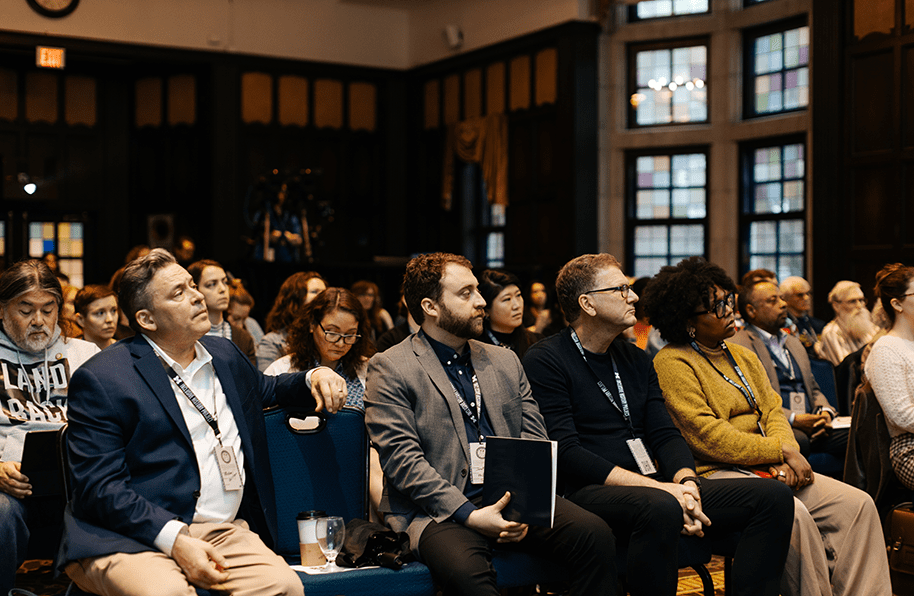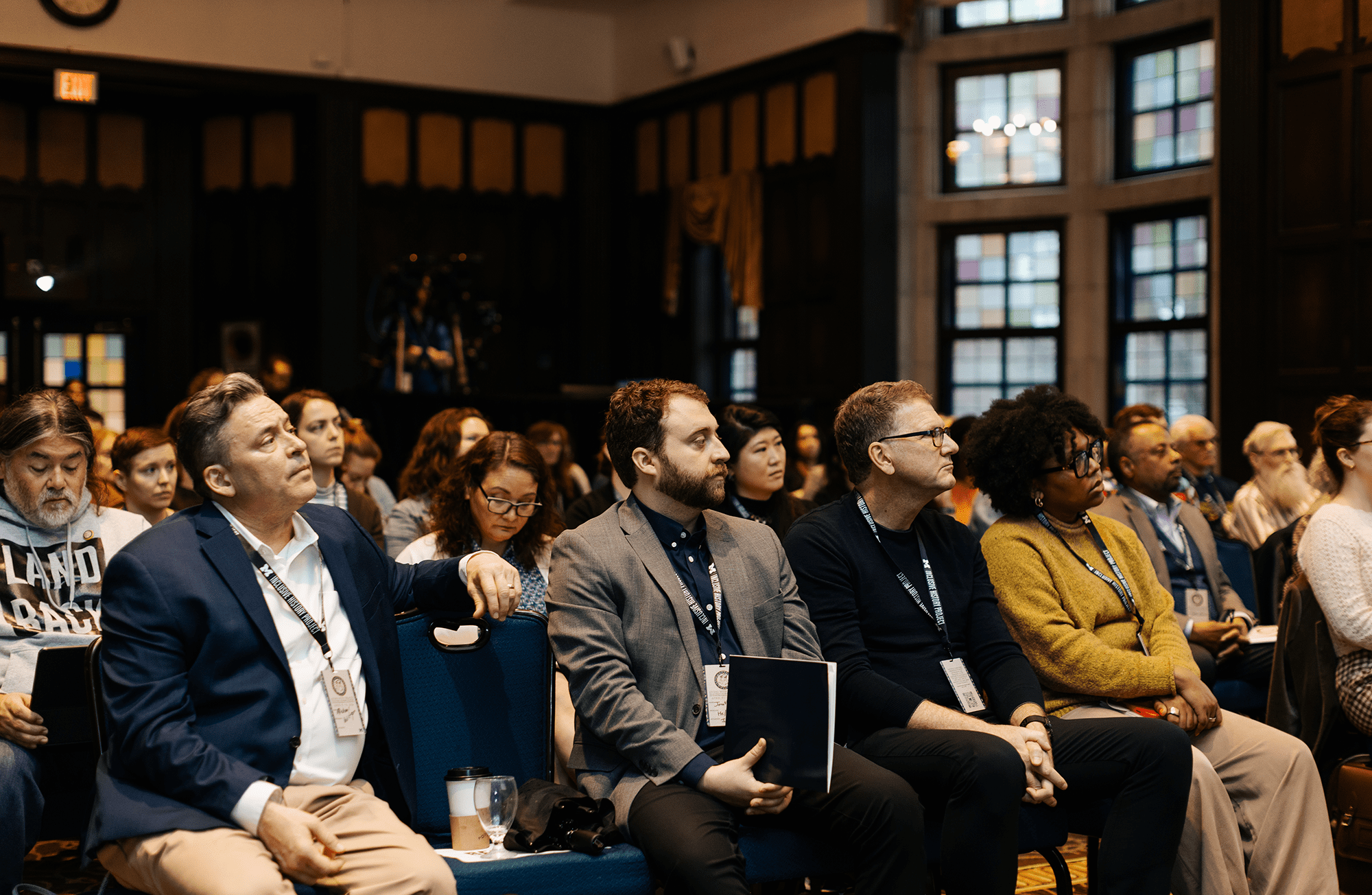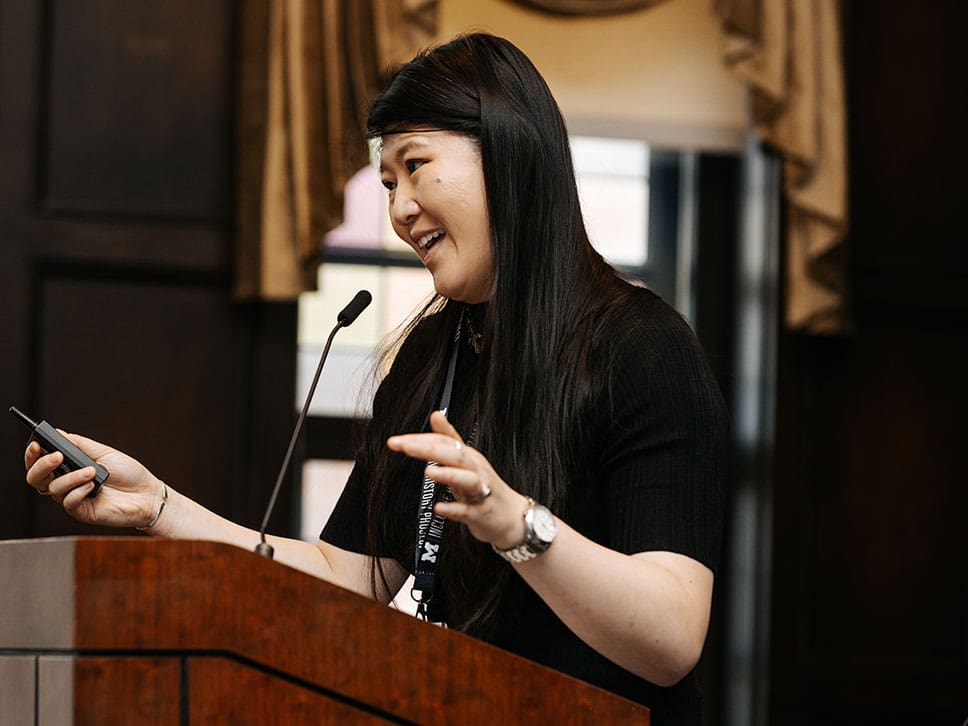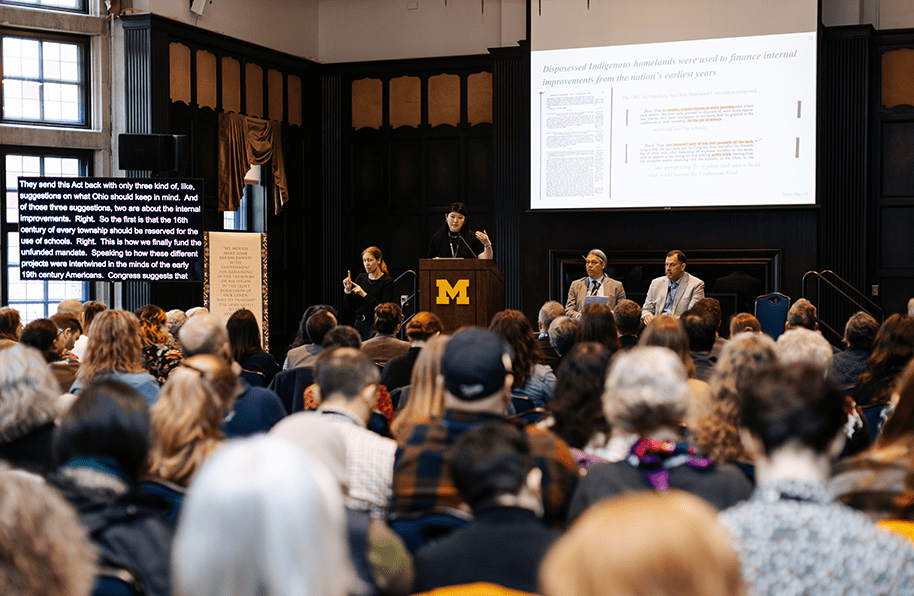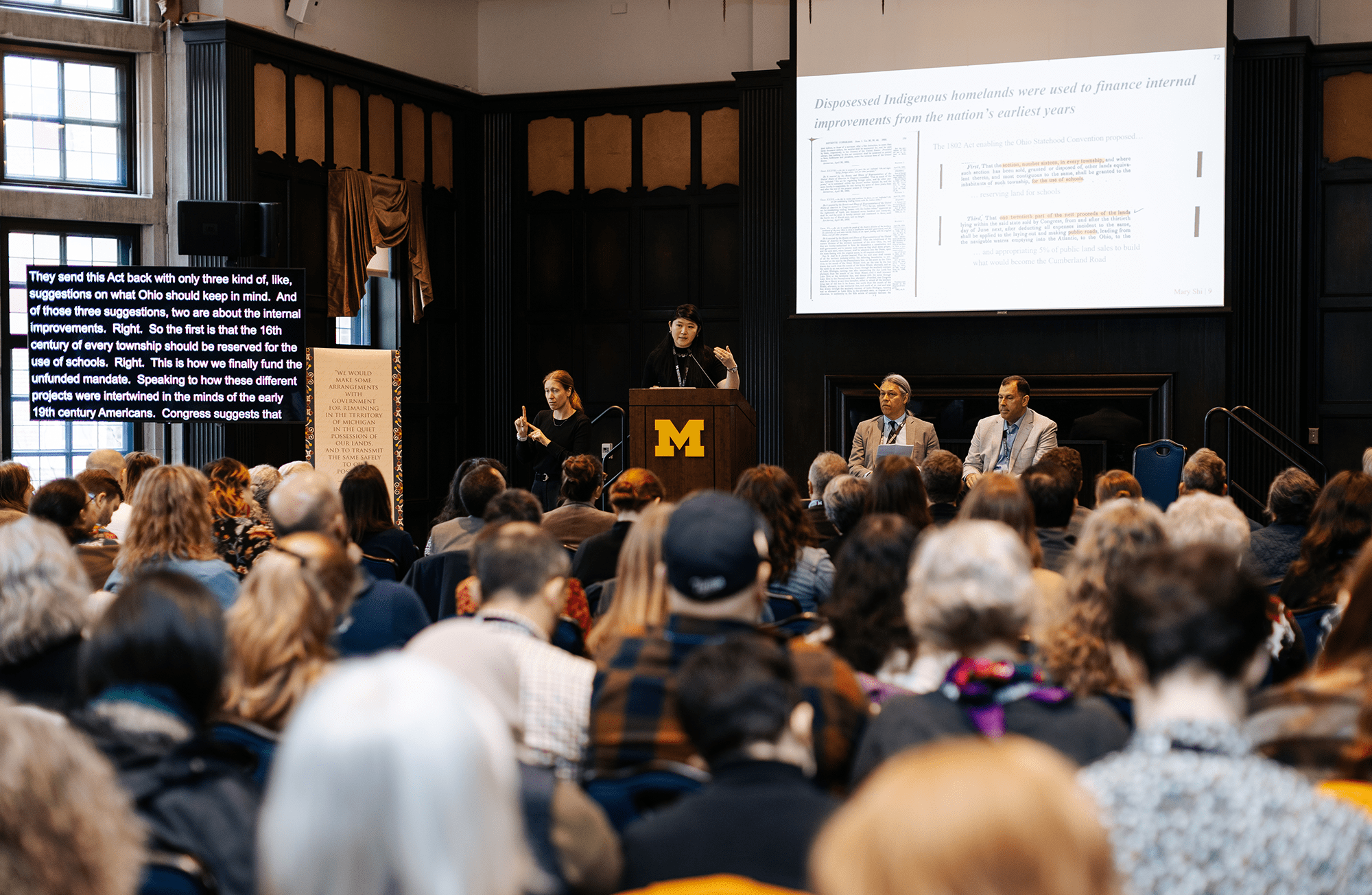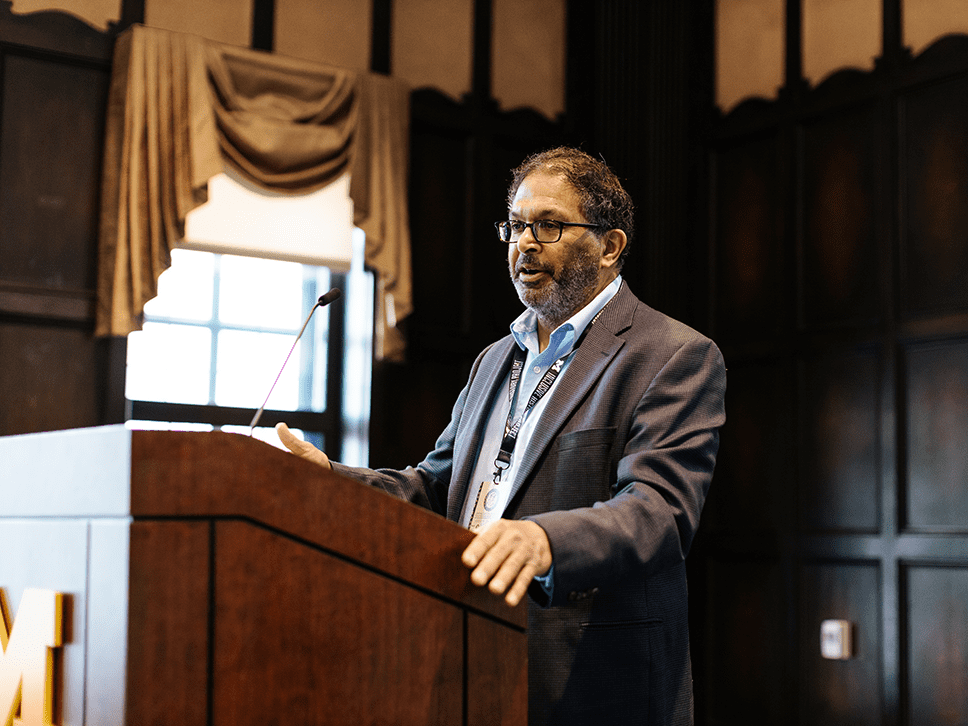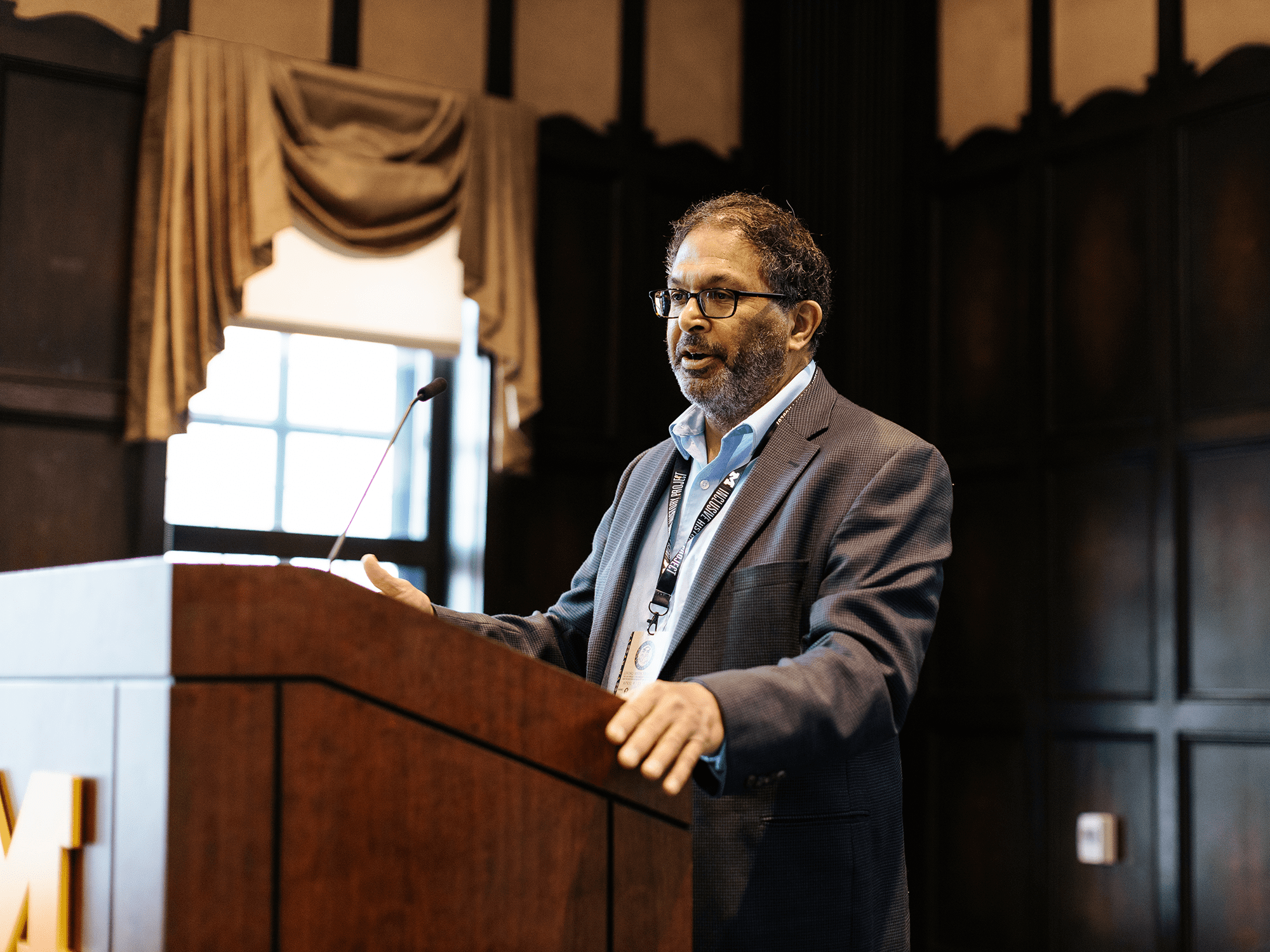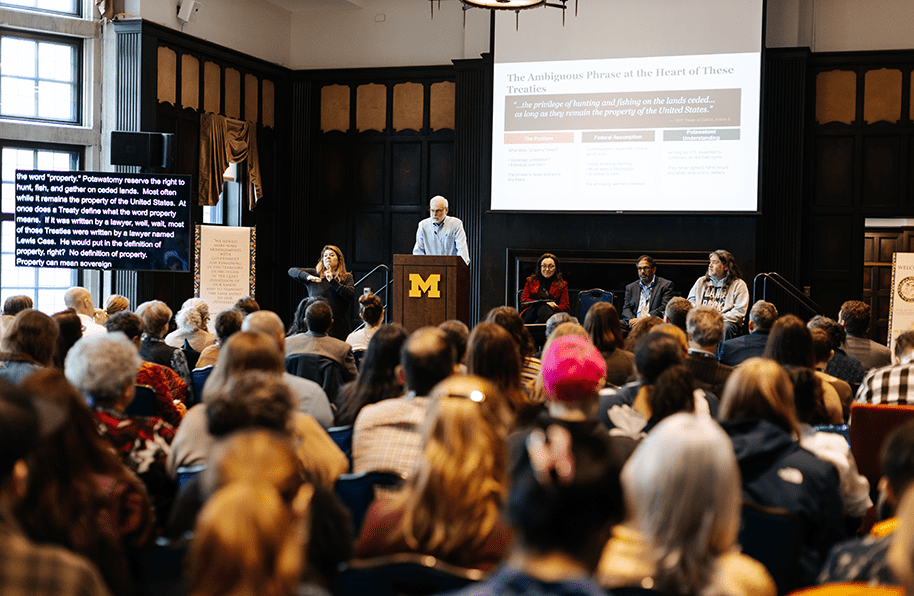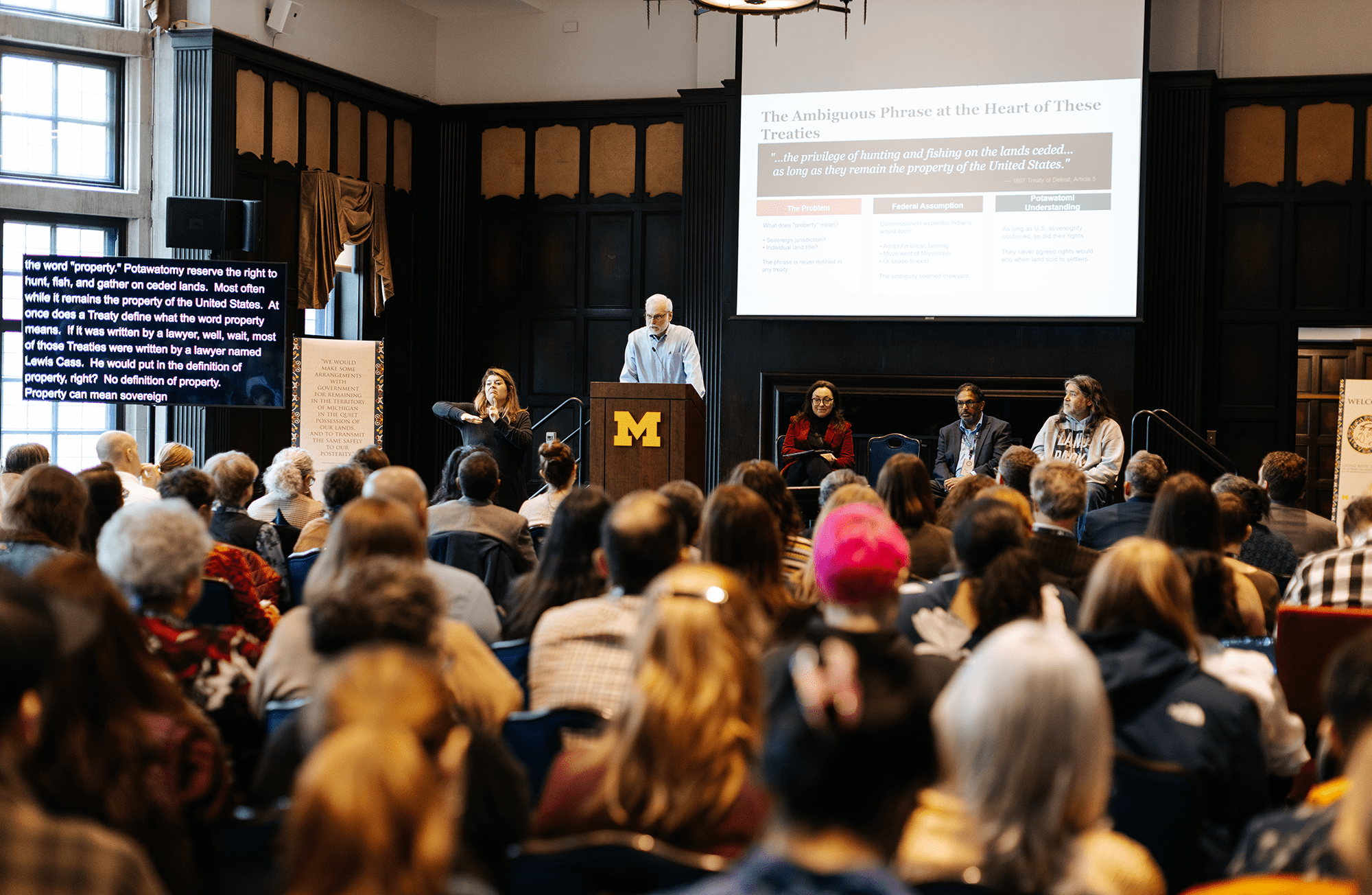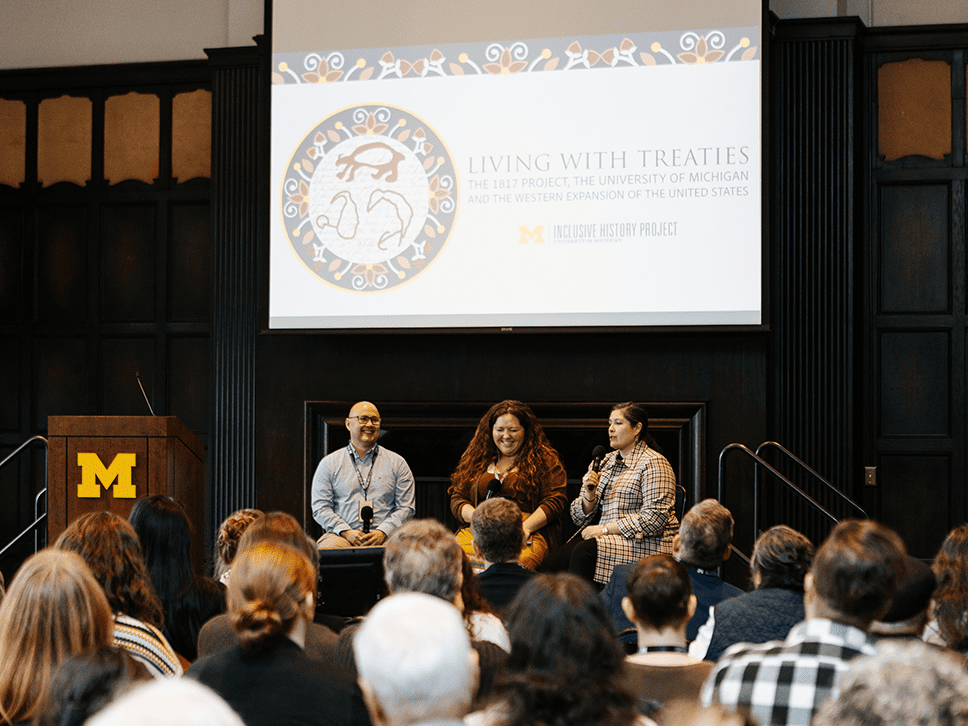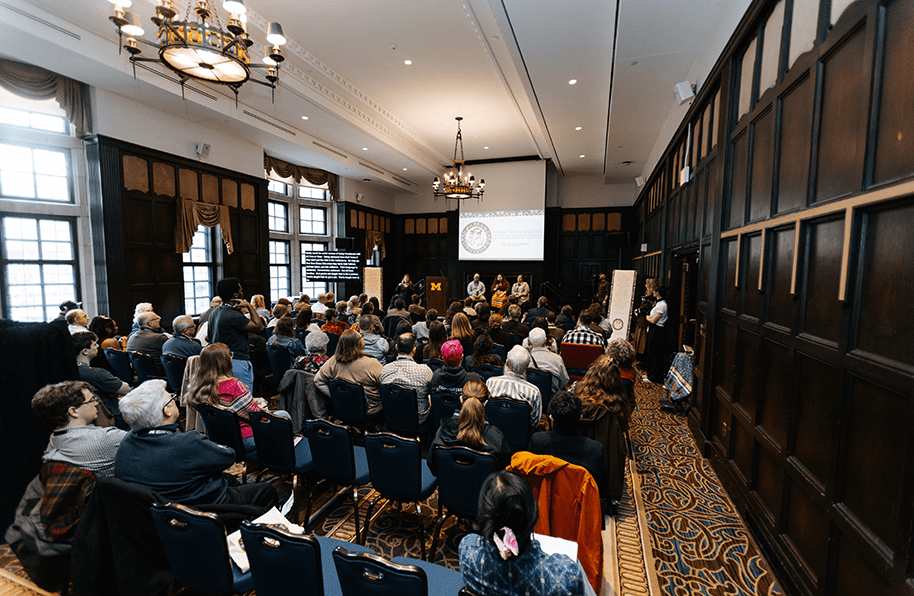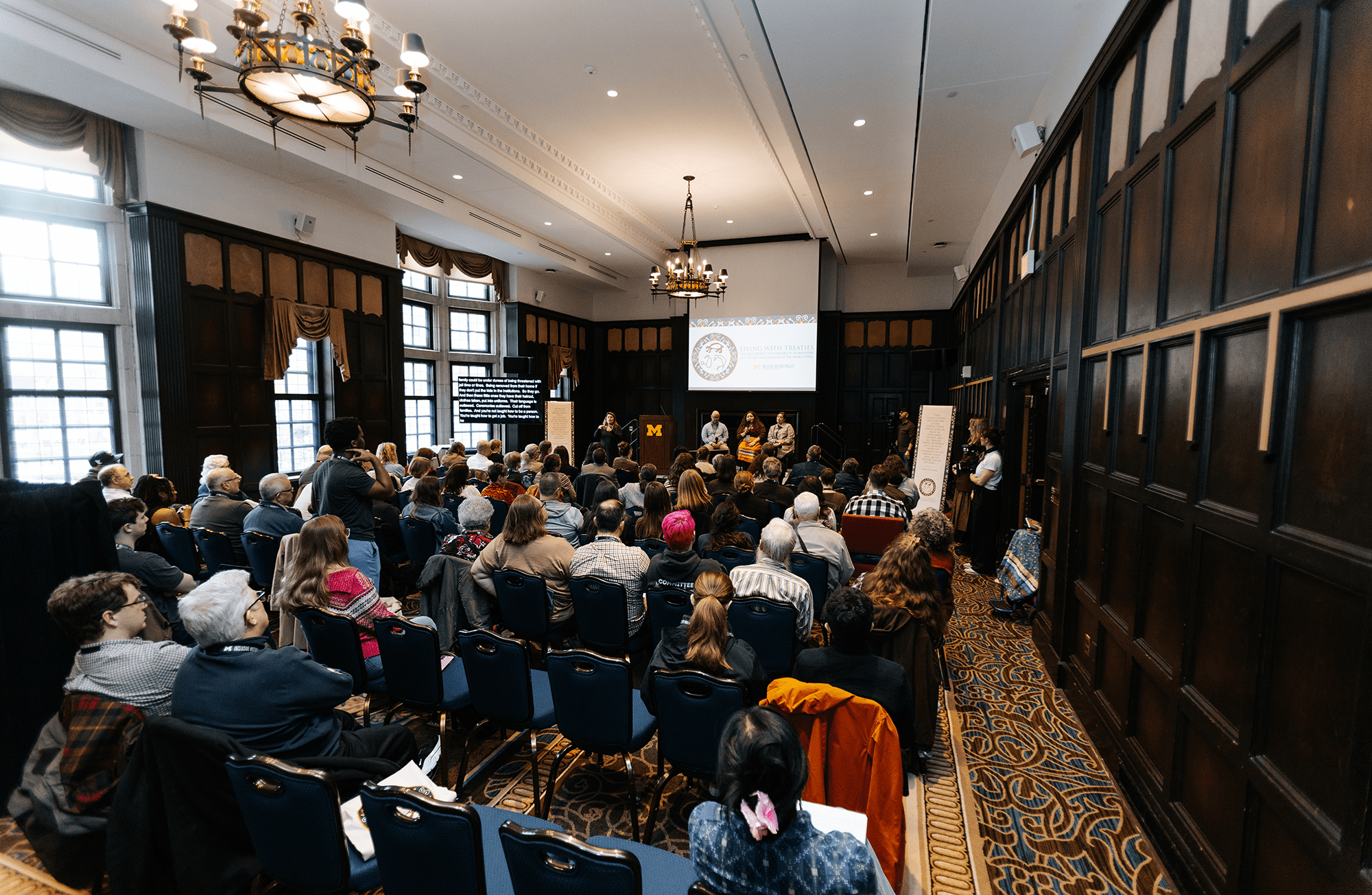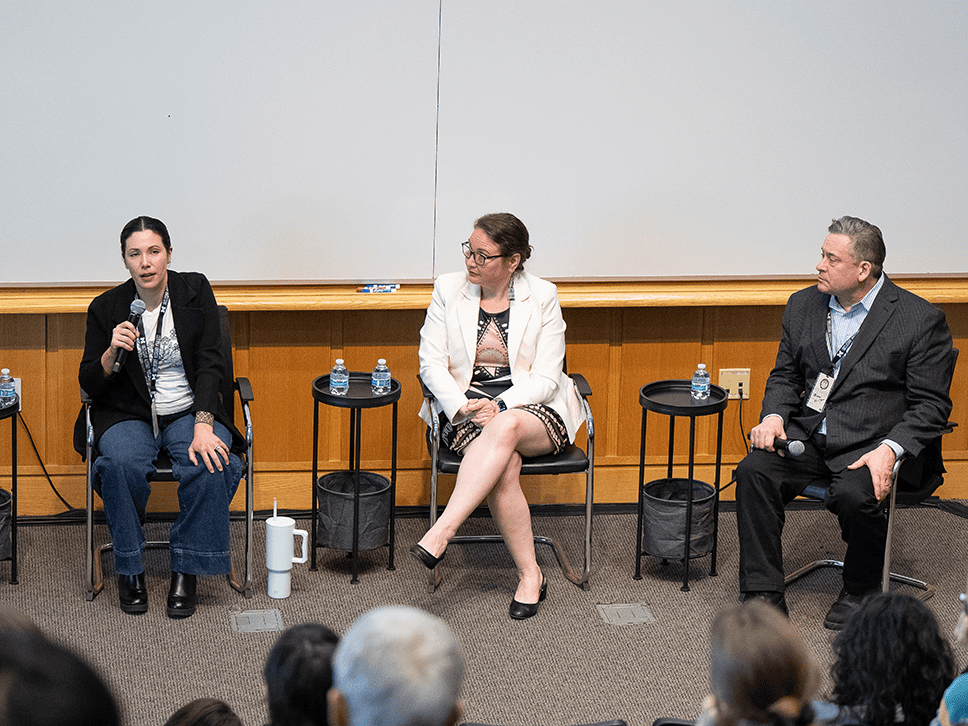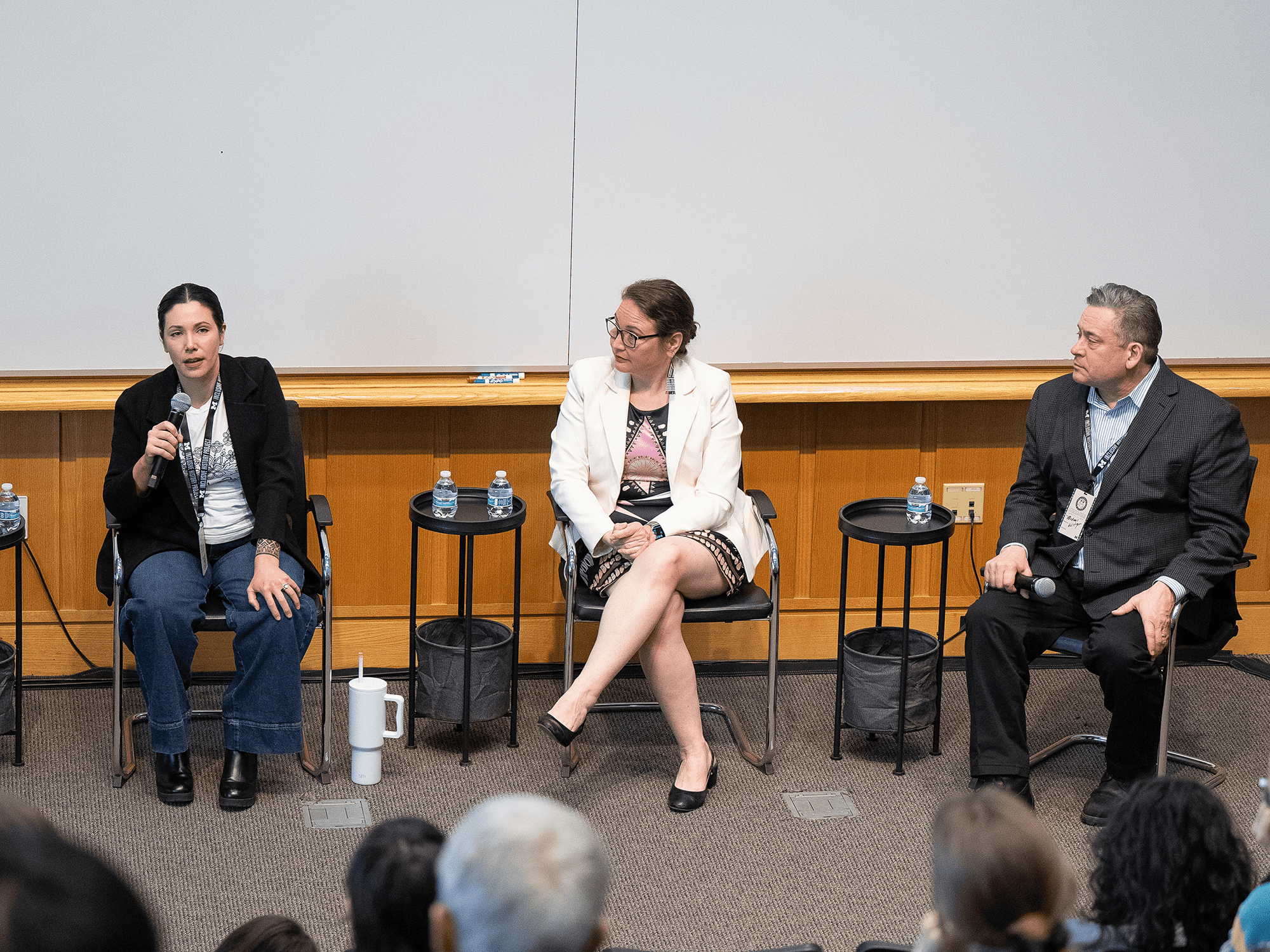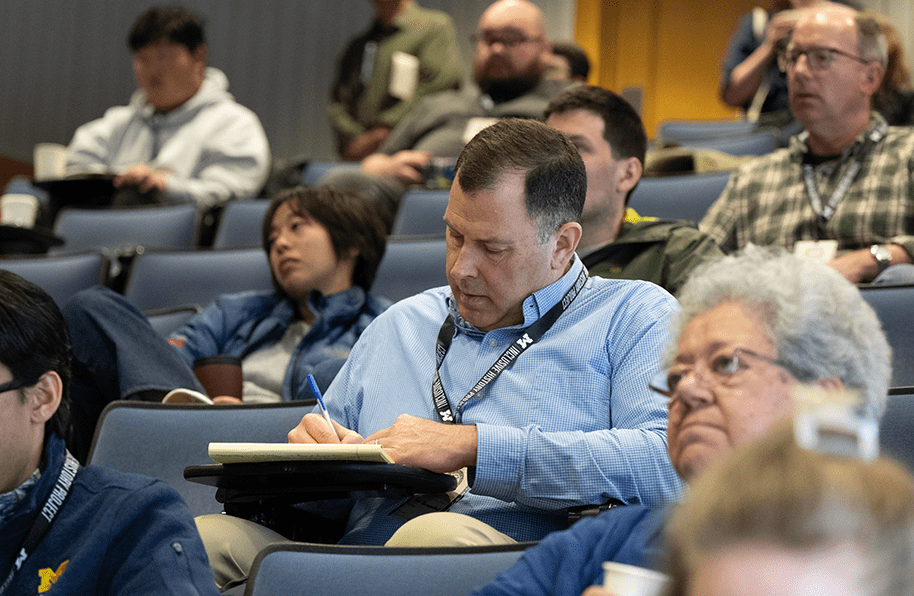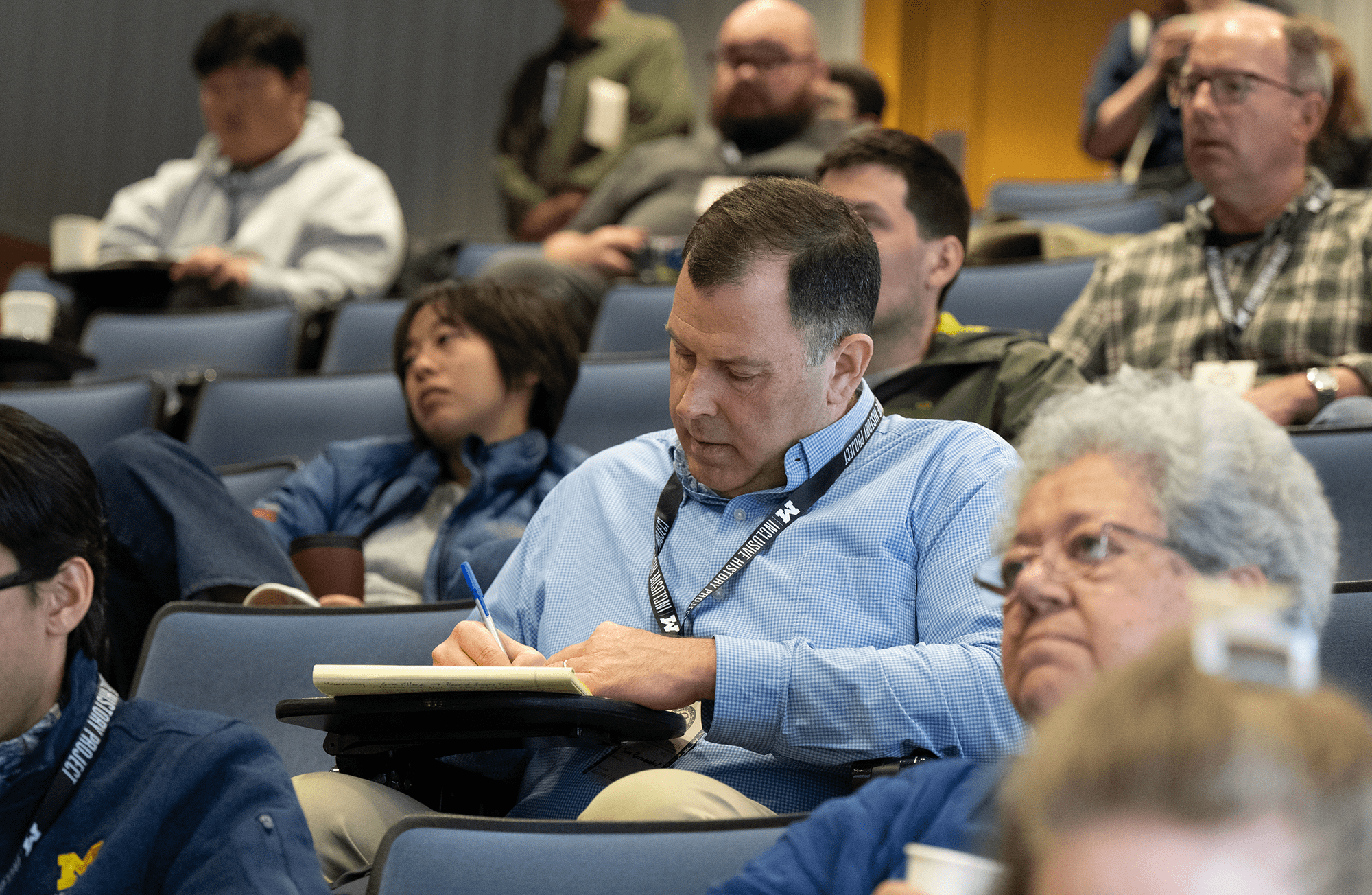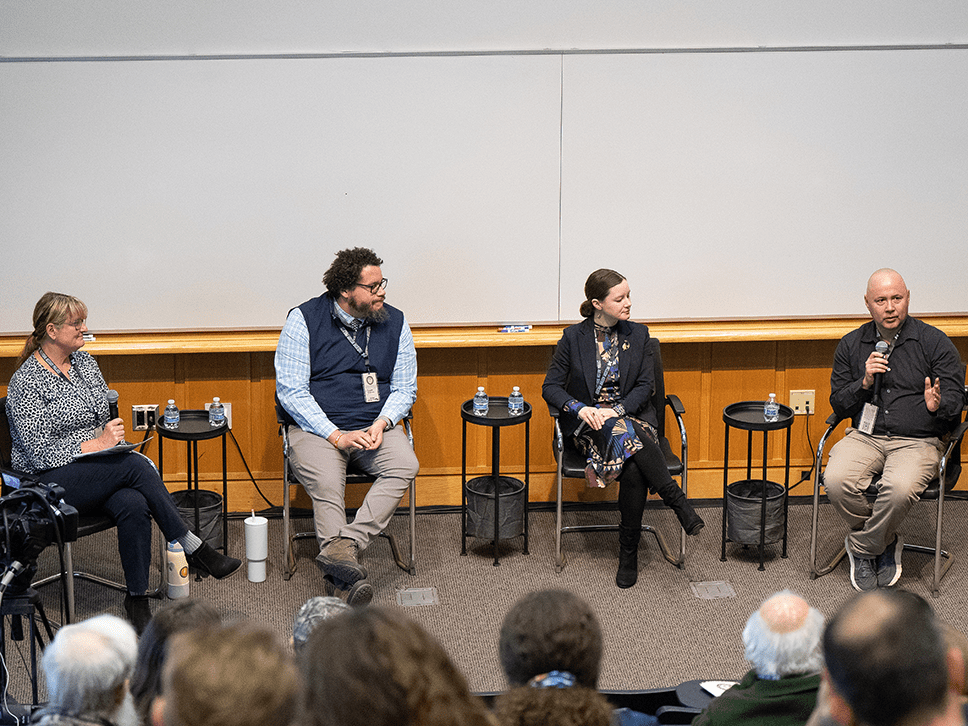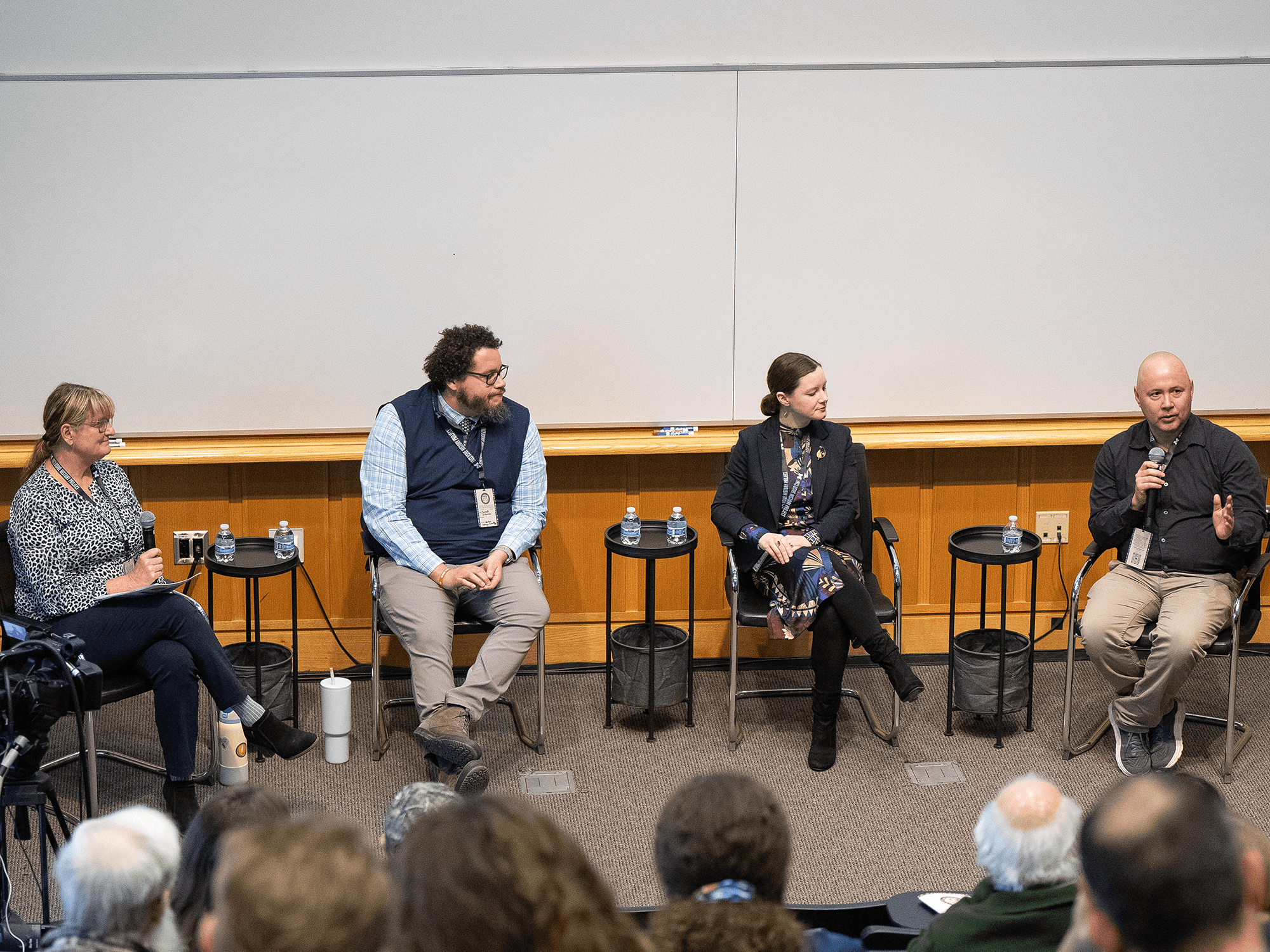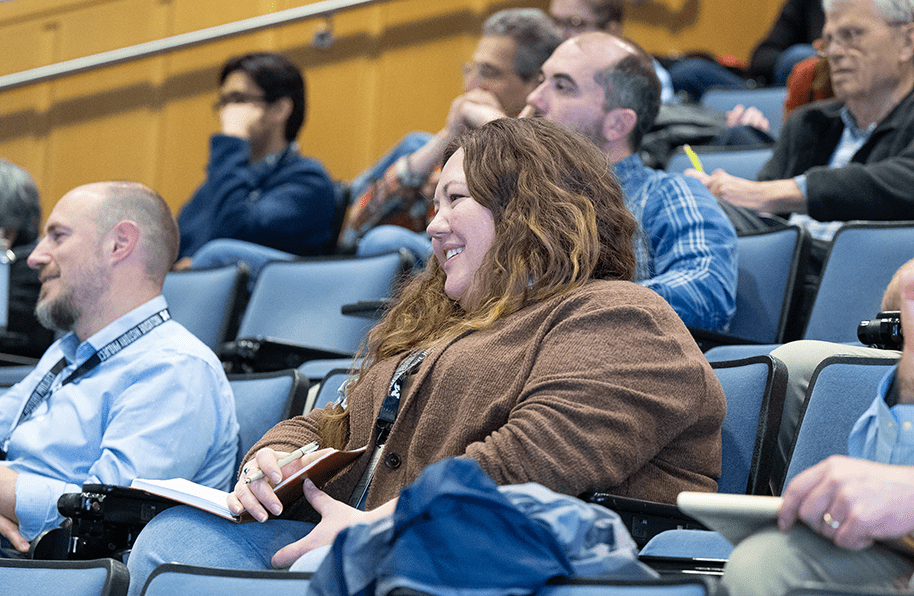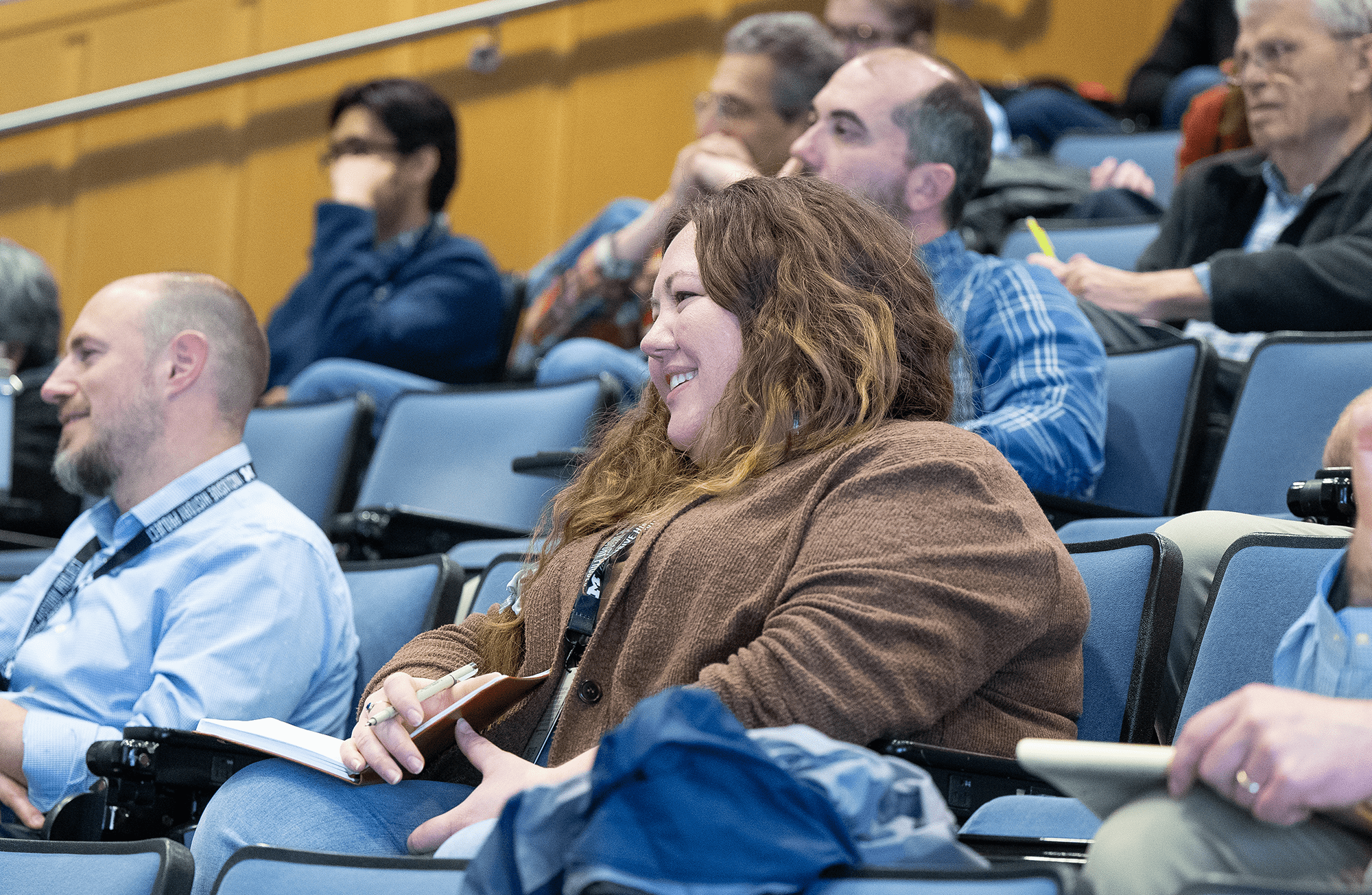
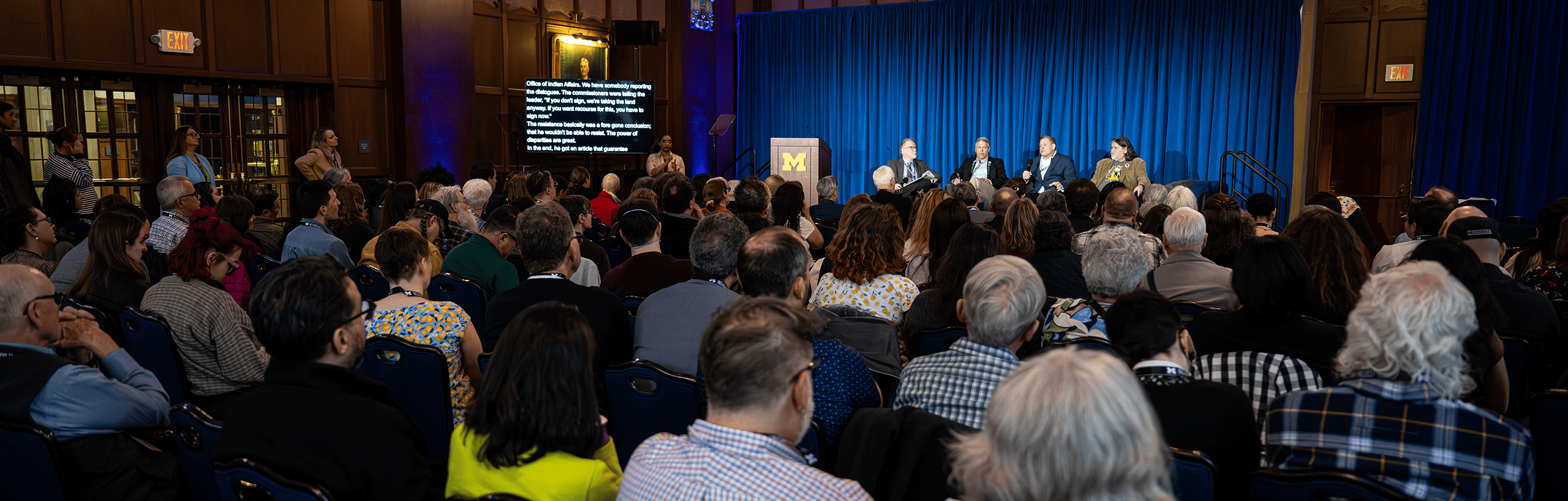
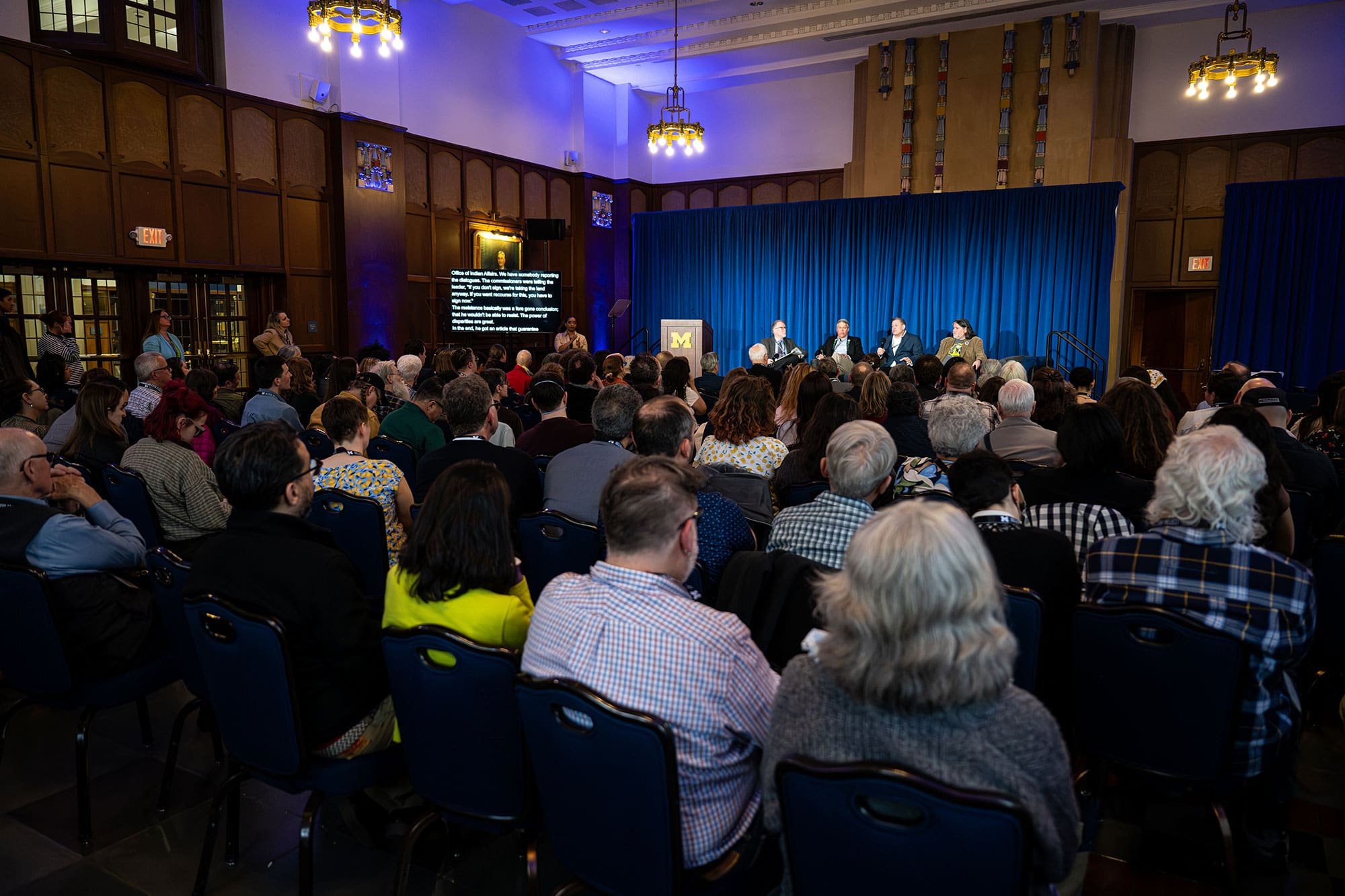
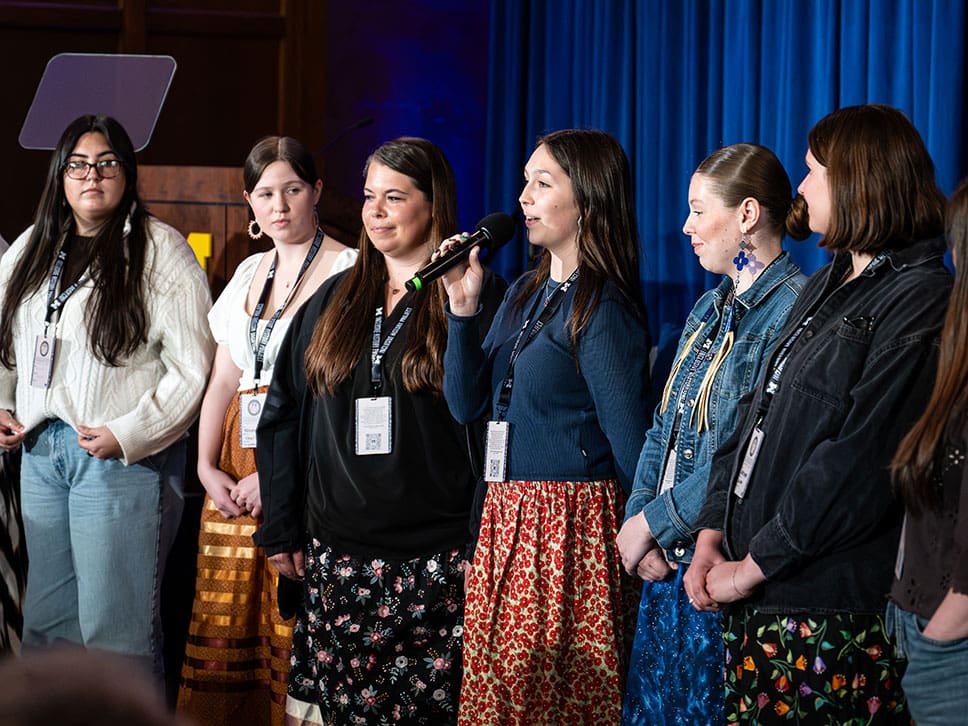
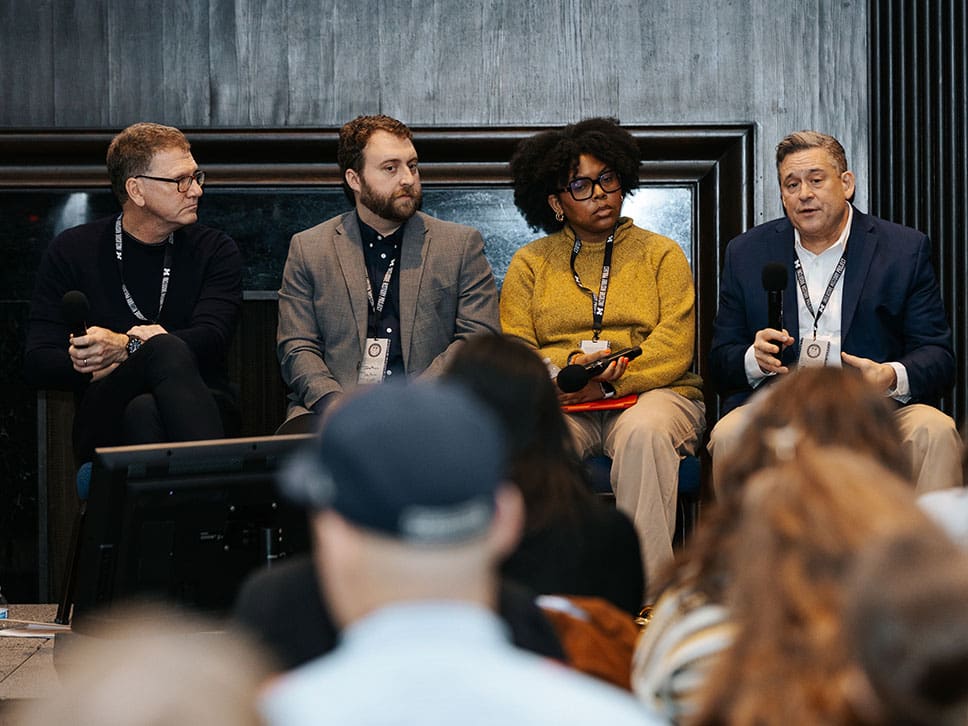
A full audience for the Living with Treaties Conference Keynote Roundtable on April 9, 2026.

Living with Treaties Conference Resources

Living with Treaties: The 1817 Project, The University of Michigan, and the Western Expansion of the United States Conference

The Living with Treaties conference, held April 9-11, 2026, explored the University of Michigan’s origins, the history of treaties, and their enduring impacts and legacies.

The conference is part of The 1817 Project: Land, Culture, Memory, and Repair, one of the major research initiatives of the University of Michigan’s Inclusive History Project. Led by Eric Hemenway, Bethany Hughes, and Michael Witgen, the 1817 Project is a multi-disciplinary examination of the foundational land transfer by the Ojibwe, Odawa, and Boodewaadamii nations in the 1817 Treaty of Fort Meigs (also known as the Treaty of the Maumee Rapids), which was part of the University of Michigan’s 1817 origins in Detroit and subsequent relocation to Ann Arbor, as well the university’s ongoing connections to Indigenous land and contemporary issues of Native American student experience.

The resources from the conference are accessible on this page, including panel descriptions and recordings, photos, and research posters by the 1817 Project’s undergraduate research assistants.
Recordings of Keynote Roundtable and Panel Discussions

What Does it Mean to Live with Treaties? A Roundtable on Indigenous History

This keynote roundtable brought together several renowned Indigenous scholars with expertise in Indigenous and U.S. history, as well as in Tribal, federal, and constitutional law. Together, they reflected on the past, present, and future of Indigenous history, including the fundamental issue of treaties and their downstream effects into the present. A central theme of this session was: where did Indigenous history start, where is it going, and what challenges and obstacles remain within the field? The panel also considered the more specific question of treaties, land, and dispossession within a broader, comparative framework that builds upon recent studies of “land grab” politics across U.S. history as a whole. Additionally, the speakers reflected on a second theme central to their scholarship: that U.S. history cannot be understood without recognizing the central role of Indigenous histories and experiences.

Panelists

  • Ned Blackhawk (Professor of History, Yale University)
  • Maggie Blackhawk (Professor of Law, New York University)
  • Matthew L.M Fletcher (Harry Burns Hutchins Collegiate Professor of Law, UM-Ann Arbor)
  • Michael Witgen (1817 Project Co-PI, Professor in the Department of History and the Center for the Study of Ethnicity and Race, Columbia University)

Moderator

  • Gregory Dowd (Helen Hornbeck Tanner Collegiate Professor, Departments of History and American Culture, UM-Ann Arbor)
The recording of the keynote roundtable begins with opening remarks by University of Michigan President Domenico Grasso and Alphonse Pitawanakwat, plus a performance by U-M Native American Student Association Drum Group “Stick City.”


Day 1 Keynote Recording

Why Study Michigan Now? Situating the University of Michigan and the Great Lakes Region in the Broader Histories of Native American Dispossession, Removal, “Land Grab” Politics, and U.S. Higher Education

This panel took as a starting point the founding moment represented by the land transfer to U-M in Article 16 of the 1817 Treaty of Fort Meigs, but widened the scope of inquiry to include subsequent treaties and land transfer schemes that facilitated the development of the university and the state of Michigan. This panel presented the “receipts,” to visually represent the transfer of wealth from Native people to the citizens of the state of Michigan.

This panel demonstrated that the histories of U-M, the state of Michigan, and the broader Great Lakes region are crucial contexts for understanding the broader histories of dispossession, removal, land grab politics, and the development of American higher education. Discussion of the 1817 Project, including an explanation of its origins and a showcase of its ongoing work, illustrated how the project is addressing fundamental questions of U.S. history.

Speakers

  • Jay Cook (IHP Research Director for the Ann Arbor campaus, Professor in the Department of History, UM-Ann Arbor)
  • Michael Witgen (1817 Project Co-PI, Professor in the Department of History and the Center for the Study of Ethnicity and Race, Columbia University)
  • Jonathan Quint (IHP Research Associate, 1817 Project)
  • Gabrielle Ione Hickmon (Graduate student, UM-Ann Arbor History Department)
The recording of this panel begins with opening remarks by Rosario Ceballo, Dean of the College of Literature, Science, and the Arts.


Day 2, Panel 1 Recording

Universities and Indigenous Dispossession

This panel explored the deep links between colonization, Indigenous dispossession, and the growth of colleges and universities in the United States. While the 1862 Morrill Land Grant College Act is often cited as a pivotal moment in the history of American higher education, centering the narrative on the mid-nineteenth century risks obscuring the broader role that Indigenous land played in underwriting American colleges and universities. Long before the Morrill Act, institutions such as the University of Michigan relied on land appropriated through treaties to finance operations, expand campuses, and diversify educational opportunities for students. At the same time, public domain land was being used for internal improvements, with universities serving as part of this larger project of development. The Morrill Act extended and formalized these practices, redistributing millions of acres of Indigenous land to fund the expansion of higher education across the United States. By bringing the pre- and post-Morrill Act eras into conversation, this panel showed how Indigenous land has remained a foundational resource for American higher education from its beginnings through the present.

Speakers

  • Jon Parmenter (Associate Professor, Cornell University)
  • Mary Shi (Postdoctoral Fellow and incoming Assistant Professor of Sociology, UM-Ann Arbor)

Moderator

  • Ned Blackhawk (Professor of History, Yale University)
Day 2, Panel 2 Recording

How to Read A Treaty: Legal Battles and the Continuing Impact of U.S.-Anishinaabeg Treaties

This panel demonstrated how important Michigan-area treaties such as the 1836 Washington Treaty and 1855 Treaty of Detroit continue to shape the lives of the Anishinaabe people of the state, and how their meaning and enforcement remain subjects of legal challenges and political activism. To show the continuing impact of treaties, and the ways in which they serve as foundational documents of Anishinaabeg-U.S. political and legal relations, our speakers drew from their experiences as legal scholars, jurists, litigators, and expert witnesses. Collectively, they discussed cases such as Little Traverse Bay Bands of Odawa v. Whitmer, which considered whether the 1855 Treaty of Detroit created a reservation for the LTBB Odawa in northern Michigan, as well as current litigation on the Line 5 Pipeline in the Straits of Mackinac and the broader historical contexts of these cases.

Speakers

  • Matthew L.M. Fletcher (Harry Burns Hutchins Collegiate Professor of Law, UM-Ann Arbor)
  • Riyaz Kanji (founding member of Kanji & Katzen)
  • James McClurken (McClurken Research)

Moderator

  • Maggie Blackhawk (Professor of Law, New York University)
Day 2, Panel 3 Recording

On the Hidden Histories of Public Domain Land

This panel explored the creation of public lands in the Michigan Territory and state through multiple treaties negotiated by the federal government with the Indigenous peoples of Michigan. Historically, federal officials pressured tribes in Michigan to agree to the extinction of Native title to their lands, even when there was no immediate demand for those lands. This meant not only that tribes were deprived of a valuable asset, but also that this asset was able to appreciate in value until such time as it was sold by the state. In order to convince Native peoples to sign these treaties, the 1836 Washington and 1855 Detroit treaties guaranteed Native peoples the right to hunt, fish, and harvest on ceded territory not yet converted into private property. Reinforcing the enduring relevance of treaties across time, this panel focused on the protests, activism, and legal battles that have emerged over Indigenous resource rights in Michiganall of which revolve around differing interpretations of land and treaties. The panel centered the experiences and insights of community members who participated in these events.

Speakers

  • Mae Wright (Tribal Historic Preservation Officer, Little Traverse Bay Bands of Odawa Indians)
  • Emily Proctor (Tribal Extension Educator, Michigan State University)

Moderator

  • Eric Hemenway (1817 Project Co-PI, School for Environment and Sustainability Humanities Program Manager, UM-Ann Arbor)
Day 2, Panel 4 Recording

How to Think About the Origins of Indian Removal Politics From a Great Lakes Perspective

This panel highlighted how two Michigan Anishinaabe communities—the Pokagon Band of Boodewaadamii and the Burt Lake Band of Odawa and Ojibwe Indians—had different experiences with removal and federal recognition, shaping their distinct paths and histories. It combined historical analysis of the development of various nineteenth-century land companies and land transfer schemes with presentations by community representatives who discussed the resistance of their communities to Indian Removal, as well as how they have fought or are still fighting to have their sovereignty and territory recognized by the federal government. This panel discussed the shifting understandings and contexts of Indian Removal, focusing on examples from Michigan and the broader Great Lakes Basin, such as encroachment from settler colonists, forced migration by military forces, and Indian boarding schools that illuminate nationally significant aspects of Indian Removal policy.

Speakers

  • Wenona T. Singel (Associate Professor of Law, Michigan State University)
  • Blaire Morseau-Topache (Assistant Professor, Department of Religious Studies, Michigan State University)

Moderator

  • Michael Witgen (1817 Project Co-PI, Professor in the Department of History and the Center for the Study of Ethnicity and Race, Columbia University)
This panel begins with opening remarks by Elizabeth Cole, co-chair of the Inclusive History Project.


Day 3, Panel 1 Recording

Teaching Native American and Treaty History in K-12 Classrooms

This panel brought together educators from public schools and library professionals to share their experiences and insights on teaching Native American history in a range of educational settings. Panelists discussed best practices for engaging students and building inclusive curricula and lesson plans, and addressed the gaps and challenges that persist in public education. Drawing on their experiences teaching Native American history, they reflected on what has proven most effective, what barriers remain, and how educators can collaborate to move this work forward.

Speakers

  • Joe Erdmann (Educator, Harbor Springs Public School)
  • Kara Johnson (Director of Teacher Programs, Newberry Library)
  • Annemarie Conway (Retired educator)

Moderator

  • Eric Hemenway (1817 Project Co-PI, School for Environment and Sustainability Humanities Program Manager, U-M)
The recording of this panel concludes with closing remarks by Michael Witgen, 1817 Project Co-PI.


Day 3, Panel 2 Recording

Posters by 1817 Project Undergraduate Research Assistants

During the Fall 2025 and Winter 2026 semesters, 1817 Project undergraduate research assistants investigated several topics related to the project’s broader examination of U-M’s connections to the 1817 Treaty of Fort Meigs, colonization, and Indigenous dispossession. Their posters were displayed at the Community Connections Forum on day three of the Living with Treaties conference.

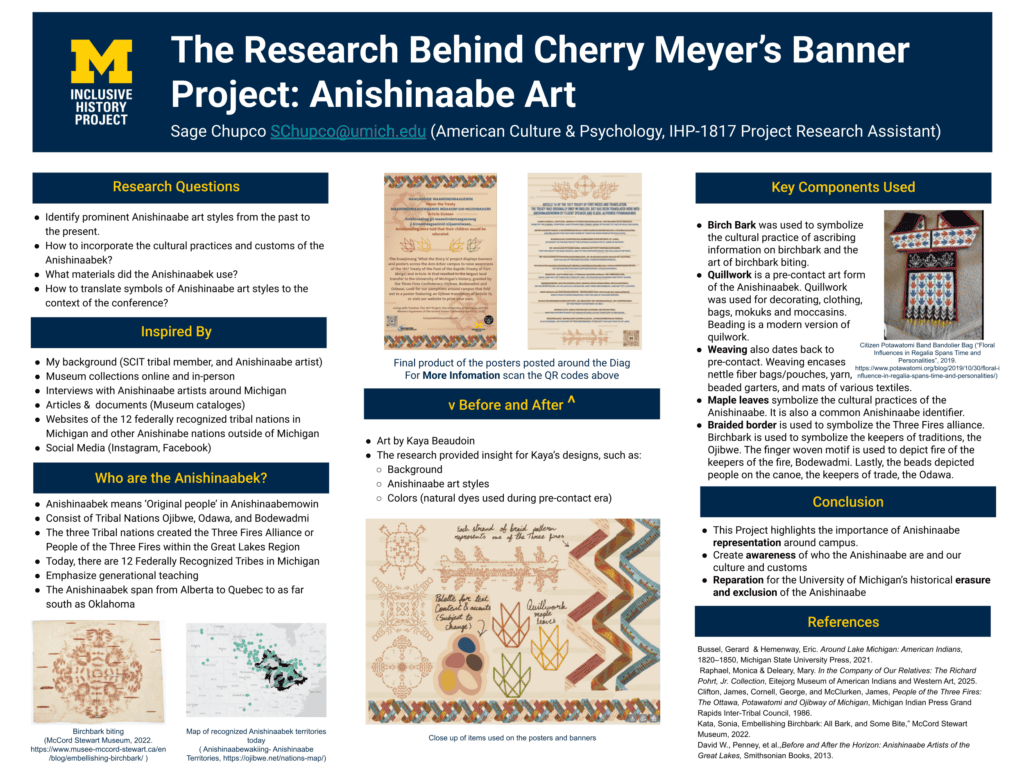
In support of Professor Cherry Meyer’s Enaajimang “What the Story is” banner and poster project, Sage researched Anishinaabeg artistic styles, materials, and methods, informing and guiding the creative development of the banners and posters. Pdf version: [LINK]

Undergraduate student Sage Chupco’s poster detailing Anishinaabeg artistic styles, materials, and methods that form the research behind professor Cherry Meyer’s banner project.


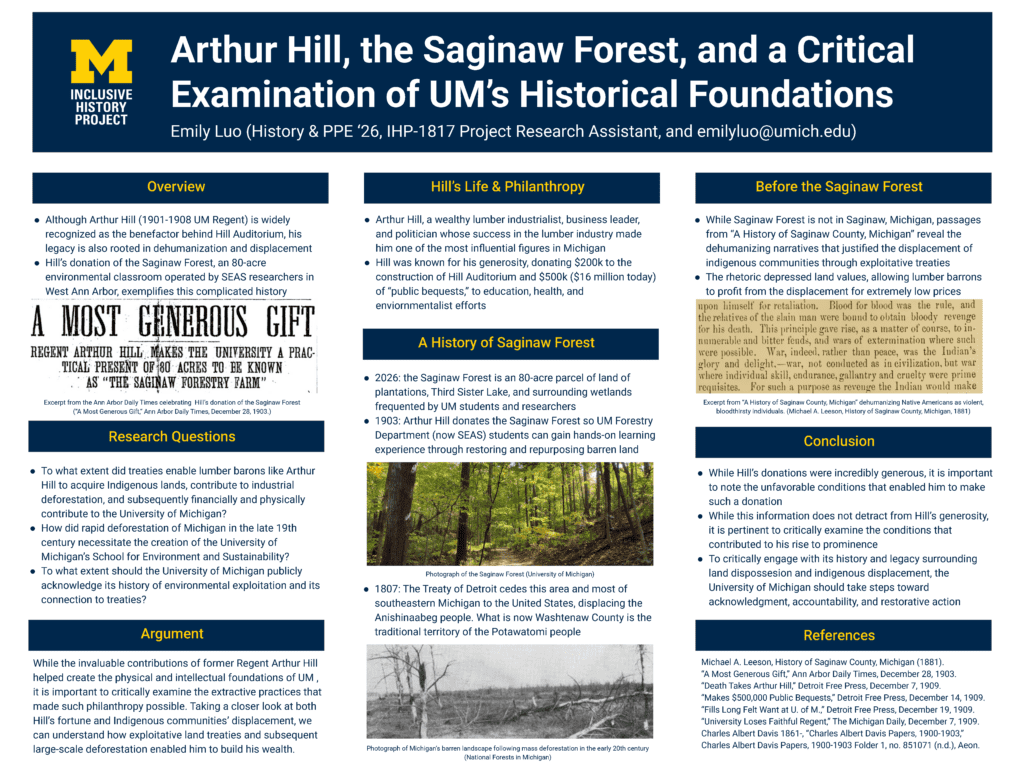
Emily investigated U-M Regent Arthur Hill’s lumbering interests in early twentieth-century Michigan, the accumulation of his fortune, and his philanthropic contributions to U-M—including the Saginaw Forest nature reserve and field research property and Hill Auditorium. Pdf version: [LINK]

Undergraduate student Emily Luo’s poster that examines U-M Regent Arthur Hill’s lumbering interests, his fortune, and his contributions to U-M in early twentieth-century Michigan.

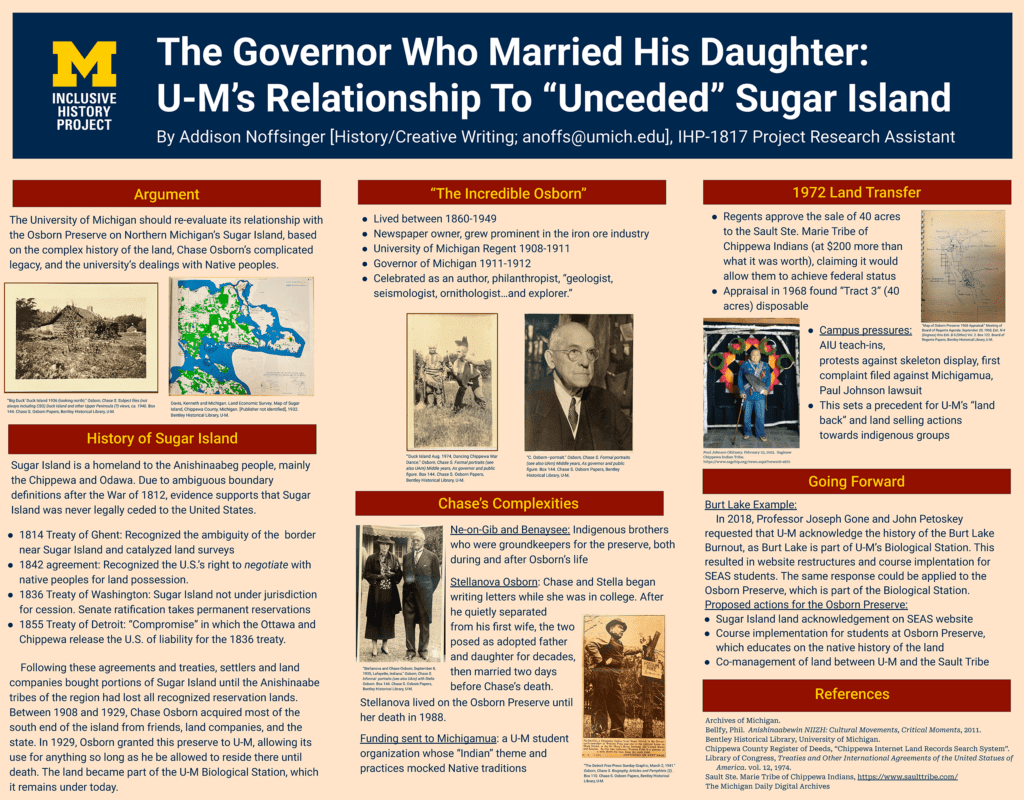
Addison uncovered Michigan Governor and U-M Regent Chase Osborn’s extensive landholdings on Sugar Island in northern Michigan, as well as the process through which the Chase. S. Osborn Preserve became part of the U-M Biological Station. Pdf version: [LINK]

Undergraduate student Addison Noffsinger’s poster uncovers Michigan Governor and U-M Regent Chase Osborn’s landholdings on Sugar Island in northern Michigan, along with how the Chase. S. Osborn Preserve became part of the U-M Biological Station.

Acknowledgments

Many voices and partners shaped the Living with Treaties Conference, and we extend our thanks to the many people, programs, and units who made the conference possible.
  • The 1817 Project is grateful for the panelists, moderators, and K-12 workshop facilitators who made Living with Treaties possible: Ned Blackhawk, Maggie Blackhawk, Matthew L.M. Fletcher, Michael Witgen, Greg Dowd, Jay Cook, Jonathan Quint Gabrielle Ione Hickmon, Mary Shi, Jon Parmenter, James McClurken, Riyaz Kanji, Mae Wright, Emily Proctor, Eric Hemenway, Wenona T. Singel, Blaire Morseau-Topache, Joe Erdman, Kara Johnson, Annemarie Conway, Jared Aumen, Madelaine McShannock, Joy Kooyer, and Jack Stearns.
  • For opening the keynote roundtable and conference, we are grateful to the Native American Student Association’s performance group “Stick City,” as well as Kayla Gonyon and Alphonse Pitawanakwat.
  • We extend a sincere thank you to President Domenico Grasso for his opening remarks.
  • We are grateful to the Eisenberg Institute for Historical Studies for partnering with us as co-sponsors for the keynote roundtable, and especially to Dario Gaggio, Joseph Ho, Elizabeth Collins, and John Carson.
  • We are also appreciative of sponsorship support from the Rackham Graduate School, the Bentley Historical Library, the William L. Clements Library, the Marsal Family School of Education, the Native American Studies Program in the Department of American Culture, the Department of American Culture, the Department of History, the Eisenberg Institute for Historical Studies, the Penny W. Stamps School of Art & Design, and the University of Michigan Museum of Art.
  • For participating in the Community Connections Forum, we thank Emily Luo, Sage Chupco, Addison Noffsinger, the Bentley Historical Library, the William L. Clements Library, the Matthaei Botanical Gardens, the IHP-funded project Restoring Native Voice at the University of Michigan-Dearborn: Reimagining the Environmental Interpretive Center and Campus Natural Area, LSA Undergraduate Education, and the U-M Library. We extend a special thanks to Frank Waln for the DJ set during the forum.
  • This conference would not have been possible without the leaders of the 1817 Project: Co-PIs Bethany Hughes, Eric Hemenway, and Michael Witgen. Jay Cook, as the IHP Research Director for the Ann Arbor campus, has also played a critical role in the 1817 Project and this conference, serving as a co-principal investigator in the crucial early stages of the project and continuing to provide guidance as it proceeds.
  • We thank the 1817 Project Advisory Committee for their ongoing guidance: Naomi Allen, Ethriam Brammer, Michelle Cassidy, Abigail Eiler, Matthew L.M. Fletcher, Jalen Greene, Brett Trevino, and Andrea Wilkerson.
  • We are grateful for the hard work and expertise of the conference planning committee: Kennedy Clark, Jennifer Junkermeier-Khan, Chanise Holmes, El Costanzo, Paige Newhouse, Mira Shetty, Megha Krishnan, and Jonathan Quint.
  • We appreciate the contributions of members of the IHP leadership team: Liz Cole, Earl Lewis, and Jenni Brady.
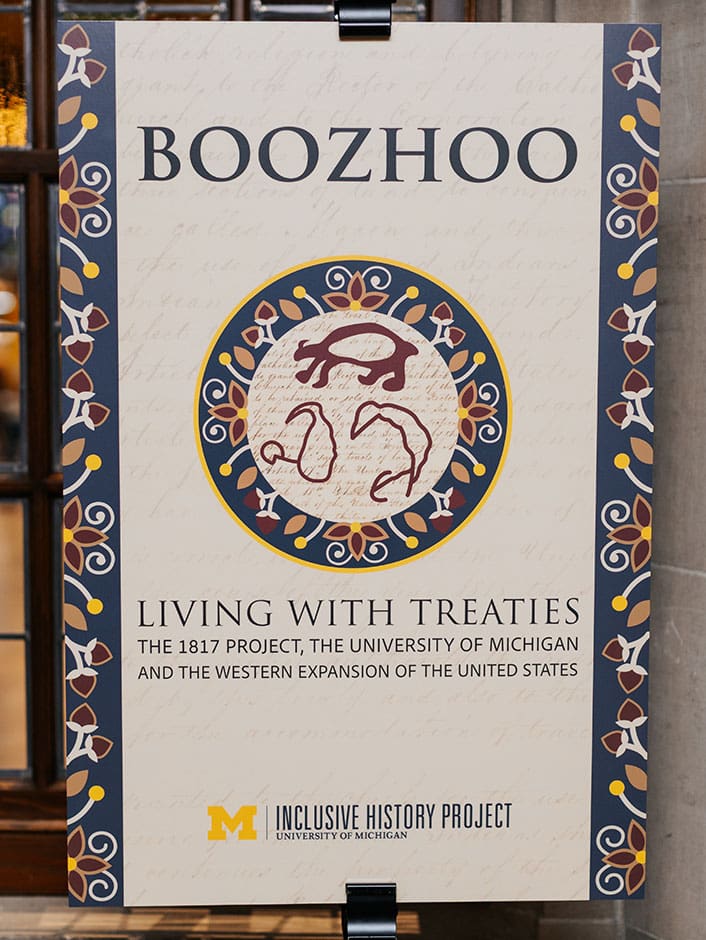
  • Graphic design for the conference was beautifully done by Eva Oldman.
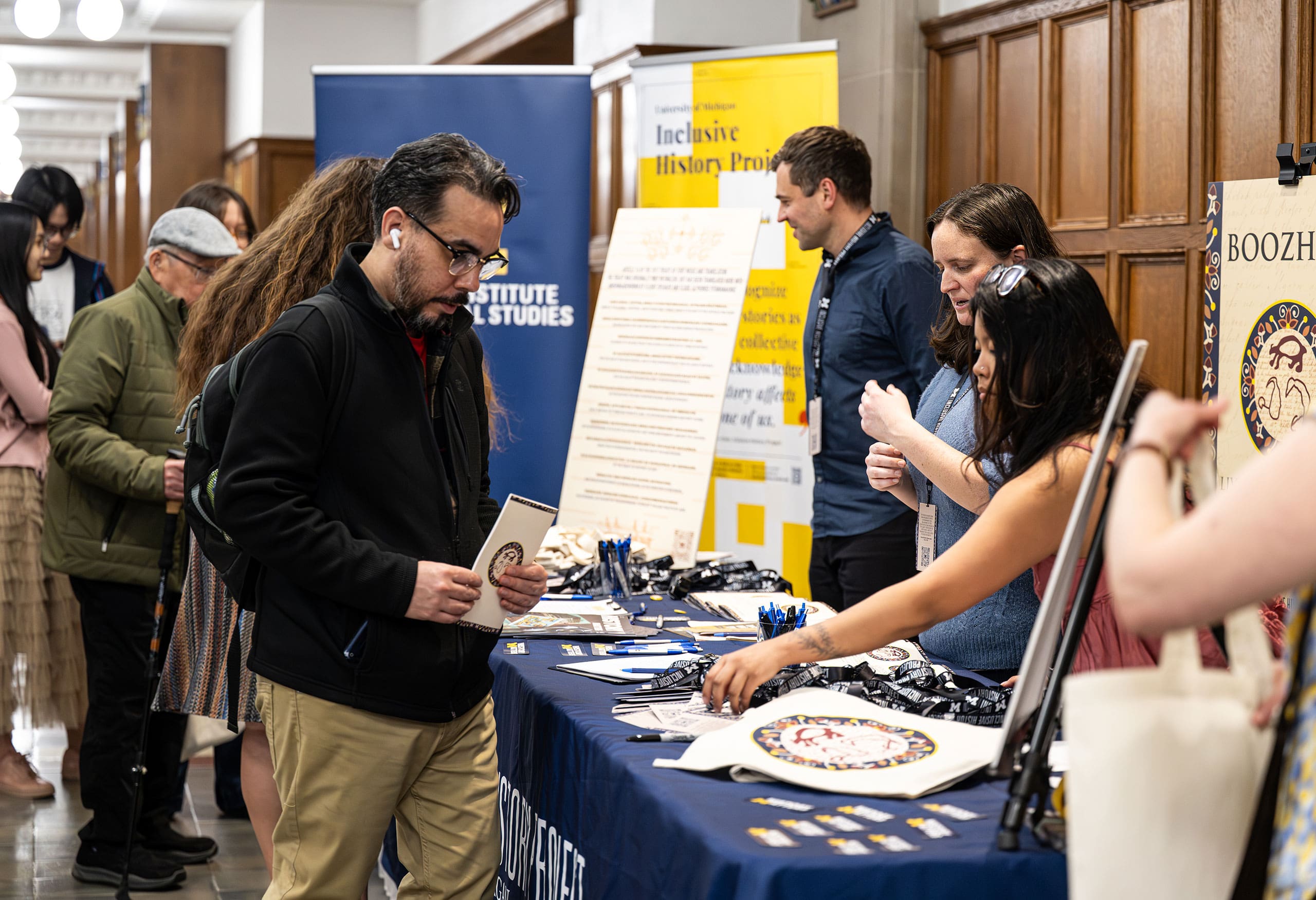
Attendees arriving at the Living with Treaties conference, and signing in at the registration table.

More from the 1817 Project

The 1817 Project: Land, Culture, Memory, and Repair originated in calls to critically examine the early history of the University of Michigan (U-M) and institutional narratives surrounding a “gift” of land the university received from Anishinaabe communities through the 1817 Treaty of Fort Meigs (also known as the Treaty of the Maumee Rapids). Bridging past, present, and future, the 1817 Project is exploring U-M’s connections to Indigenous land, settler colonialism, and policies of dispossession, as well as contemporary issues of Native American student experience, campus inclusivity, and student activism.

To stay up to date on the 1817 Project, please sign up for the IHP newsletter.