


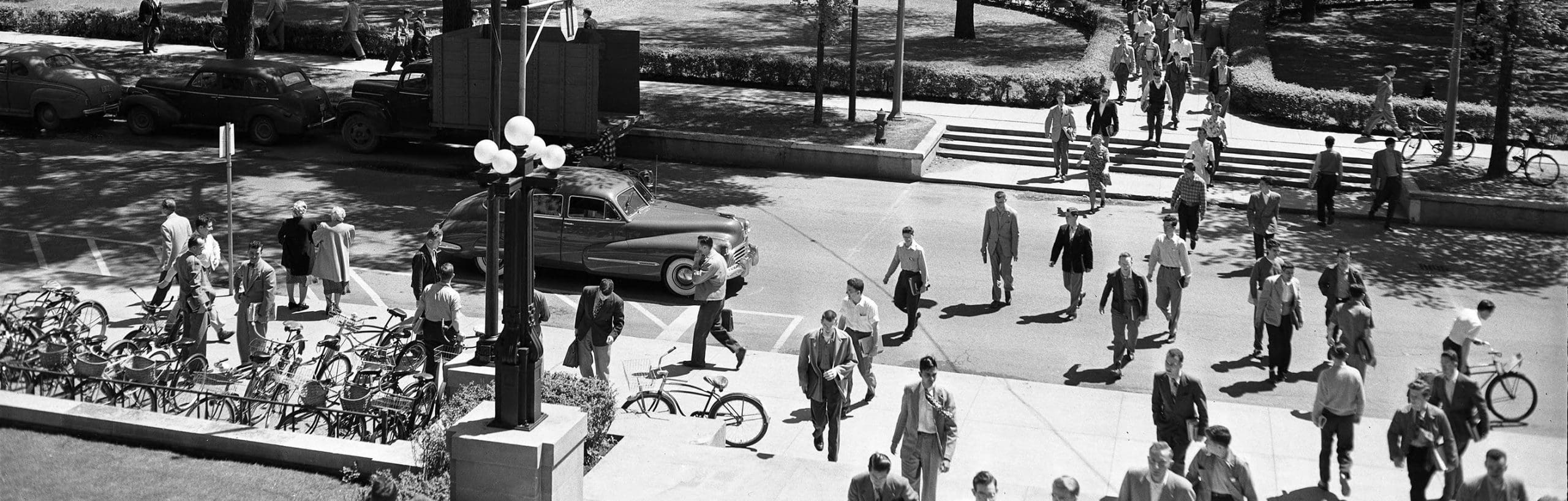
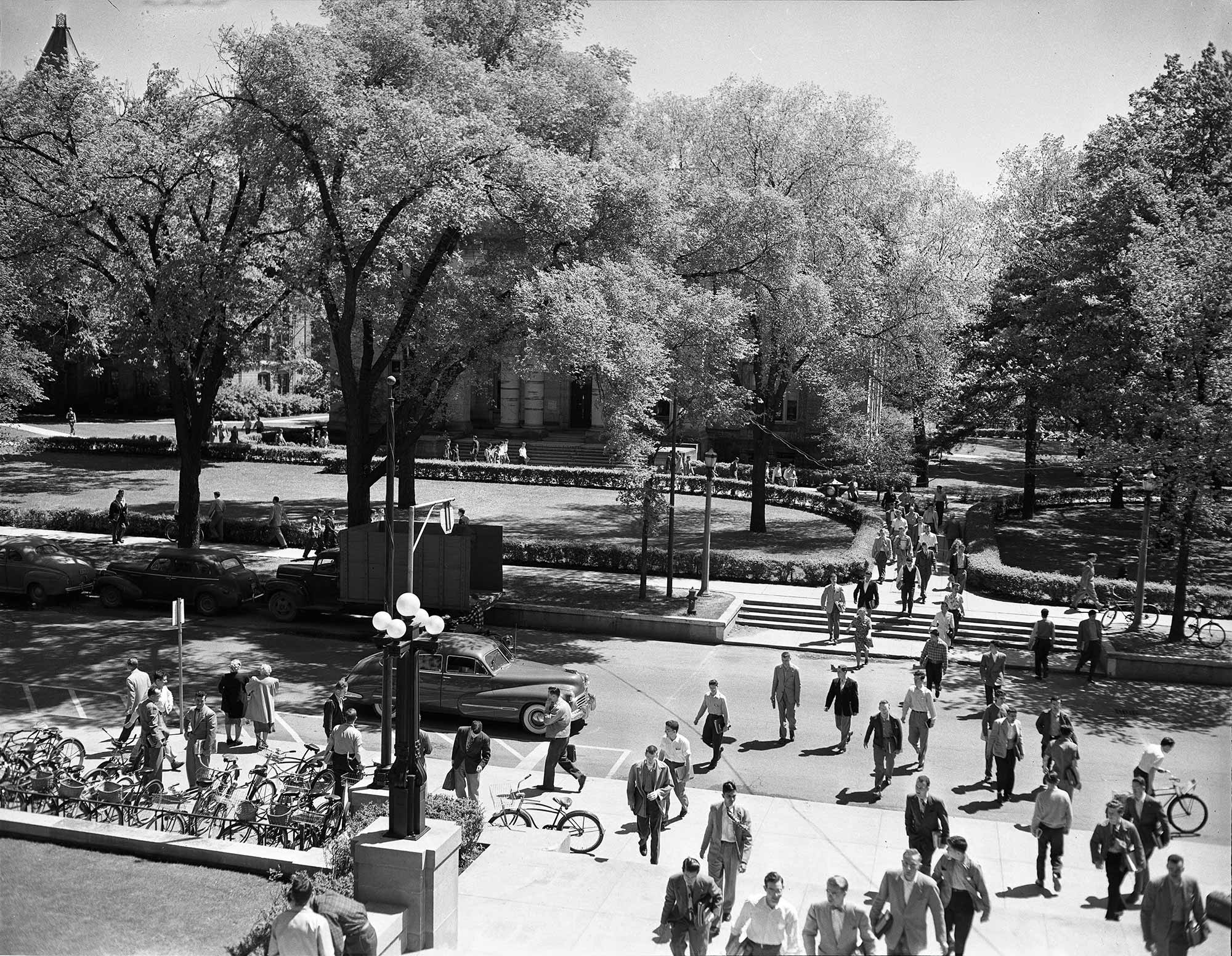
The Enaajimang ‘What the Story is’ project displays banners and posters across campus to raise awareness of Article 16 of the 1817 Treaty of the Foot of the Rapids, commonly called the Treaty of Fort Meigs. This treaty resulted in one of the largest land transfers to the University of Michigan in its history, granted by the Three Fires Confederacy, so that their children may be educated, as stated in Article 16 of the treaty. This display coincides with the IHP’s Living with Treaties conference, April 9-11, 2026, an outcome of the IHP project site of the 1817 Project: Land, Culture, Memory and Repair. The project is led by Native American Studies faculty and grew from a grant project funded by the Humanities Collaboratory.
Download a pamphlet about the project, which includes a poster of the Anishinaabemowin translation of Article 16 of the treaty. Dates and locations for the Enaajimang Poster and Banner Project are listed in a downloadable PDF map.
The Three Fires Confederacy
The People of the Three Fires is a confederacy between the Ojibwe, Odawa, and Bodewadmi nations within the Great Lakes Region. The nations collectively identify as the Anishinaabeg, or “original peoples.” The Ojibwe are thought of as the elder brother, the “keepers of tradition.” The Odawa are seen as the middle brother, “keepers of trade.” Lastly, the Bodewadmi, as the youngest brother, are “keepers of the fire.” The Anishinaabeg are still in the homelands we have looked after for centuries through hunting, fishing, gathering, and farming, never taking too much or wasting materials. We have passed these teachings from generation to generation, to give thanks to the plants and animals, for giving their life to help us live. Taught through oral tradition or the art of our ancestors, these teachings tell a story of bloodline, cultural continuity, and knowledge.
Article XVI and translation
Translated by Alphonse Pitawanakwat
Some of the Ojibwa, Chippewa, and Potawatomy tribes, being attached to the Catholic religion,
Aanin Ojibwaa, Chippewa, minwaa Potawatomi bemaadzijik, zhitwaawin wiijiiyemagak,
and believing they may wish some of their children hereafter educated,
Minwaa debwetaming ji bgosendamowaad aanin dabinoojiinhmowaanh ji kinomaagaaznid.
do grant to the rector of the Catholic church of St. Anne of Detroit,
Bigidnigaaza genwendang namegamig eteg Detroit, St. Anne,
for the use of the said church, and to the corporation of the college at Detroit,
Wii-nakaazad wi namegamig, minwaa Detroit kinoomaagegamig,
for the use of the said college, to be retained or sold,
wii-nakaazang wi kinoomaagegamgoong, Wii-mjiganagaadek maage wii-daayiing,
as the said rector and corporation may judge expedient,
Wa ewaayiinjgaazad genwenjiget minwaa kinoomaagegamig daa-dabaakwanaanan weyiip,
each, one half of three sections of land, to contain six hundred and forty acres,
Bebezhik, aapta nswi kiin. Ji temagak ngodwaaswaak-shi-niimdana kiin,
on the river Raisin, at a place called Macon; and three sections of land not yet located,
Nmebiniziibiing, Macon ezhnikaadek; minwaa nswi kiinsan mshi-mkigaadesinoo,
which tracts were reserved, for the use of the said Indians,
Niwe kiinsan gaa shkonagaadegin, Nishnaabek ezhi-nikaazijik wii-nakaazwaad,
by the treaty of Detroit, in 1807;
Wi gaa waawiindimaageng Detroit, gii-mdaaswi-shi-nshwaaswaak-shi-niizhwaaswi;
and the superintendent of Indian affairs, in the territory of Michigan,
minwaa kchi-gimaa Nishnaabe aadziwin, Michigan kiing,
is authorized, on the part of the said Indians, to select the said tracts of land.
bigidnigaade, Nishnaabek ezhinikaazijik, ji zhiigoonmowaad kiinsan.
Design Inspiration
The design elements of Enaajimang ‘What the Story is’ are rooted in Anishinaabe artistic traditions and materials, including abstract floral forms, animal and leaf motifs, and natural materials such as plant fibers, porcupine quills, wood, and birchbark. Sage Chupco researched the distinctive art styles of Anishinaabe nations, along with common materials, techniques, and symbols of Anishinaabe artistry. This research guided Kaya Beaudoin’s graphic design for the project.
Design motifs in Anishinaabeg art have been influenced by exchanges within the Three Fires Confederacy and with other tribal nations.
- Bodewadmi art is distinctive for using abstract forms of florals. The Bodewadmi were influenced by the southern neighboring tribes of their homelands, such as the Kickapoos, Sauk, and Meskwaki peoples.
- The Odawa and Ojibwe have similar art styles. They are also similar to neighboring tribes of the region, such as the Menominee and Ho-Chunk. Something distinctively different in Ojibwe art, particularly among western tribes, is the use of more focal, larger floral and leaf motifs.
- Otter tail motifs are common across the Great Lakes region.
The Anishinaabeg use materials from the surrounding environment.
- Nettle and basswood fiber are used to create woven bags, which store food and hold ceremonial items. To create patterns on the bags, a darker thread, commonly bison wool, is used.
- Natural dyes were used to color textiles, quills, and wood in the pre-contact period. Sumac created a bright crimson color. Bloodroot plant was used to dye wood orange and to make red dye. Rotting maple log was used to create purple dye for quills. Fungi was used to create different colors such as a bright green-blue.
- Birchbark is used to create an array of cultural items such as makak (containers), canoes, and scrolls, as well as patterns and motifs. On items such as makak and canoes, patterns are etched with a sharp object, creating a contrasting effect. Birchbark is also used to make cut outs of motifs to be used with quill and bead work. Birchbark biting is used by Anishinaabekwe (Anishinaabe women) to create symmetrical patterns using their eye tooth for distinct lines and molars for shading. Birchbark biting is a social activity and storytelling medium.
The Anishinaabeg use sophisticated techniques.
- Quillwork is a pre-contact Anishinaabe art form that was used for practical purposes such as labeling, as well as decoration on makaks, clothing, bags, and moccasins. Quills were dyed with the natural dyes listed above. Beginning in the fur trade era, synthetic dyes may be used.
- Weaving, which also dates back to pre-contact, was used to make nettle fiber bags/pouches, yarn garters, and mats of different textiles (cattail leaves and nettle fiber). These items were woven with a heddle or finger woven.
- Beading was introduced during the fur trade era through contact with Europeans. In early beading techniques, heddle weaving was used. The early techniques were limited to geometrical patterns, often with repeating motifs. Later, single-point stitching allowed for many of the organic motifs that we see today.
- Tattoos are another art form found in Anishinaabe nations, where they are used to signify clan membership. To make ink, crushed white cedar charcoal is diluted with water. Three pointed bones are then dipped in the ink and pricked onto the skin.
Context of Treaties
The 1817 Treaty of Fort Meigs (also called the Treaty of the Maumee Rapids or Treaty of the Foot of the Rapids) came at a time of profound upheaval for the Anishinaabe and Wyandotte peoples of what is now Michigan, following nearly a century of resistance to colonization. Land loss, disease, violence, and relentless pressure from settlers, government agents, and missionaries left them little choice but to negotiate treaties with the United States.
During September 1817, Indigenous leaders and American treaty commissioners met for negotiations the commissioners described as “troublesome and tedious.” Partly due to language barriers and the need for translators, but more importantly because of the consensus-based diplomatic practices of Indigenous communities, which sought a unified position, several weeks passed before an agreement was reached on September 29, 1817.
Although most of the treaty dealt with Wyandotte land in northwestern Ohio, Article 16 concerned Anishinaabe land in the Michigan Territory, granting “six sections,” or 3,840 acres of land to the “college at Detroit,” understood as the Catholepistemiad, or University of Michigania, the predecessor to the University of Michigan, as well as Sainte Anne de Détroit, Detroit’s Catholic church. The three sections claimed by the university were reservation lands–some of the few remaining lands the Anishinaabeg held in southeastern Michigan, and the proceeds from the sales of this land helped U-M’s leaders develop the institution.
Some Anishinaabeg had preexisting relationships with Father Gabriel Richard, a Catholic priest who served as the rector of Saint Anne and the vice-president of the Catholepistemiad. During the early 1800s, several Bodewadmi children attended the “Spring Hill” school near Detroit that Richard ran with the help of an elder Bodewadmi matron. Additionally, as the treaty noted, some of the Anishinaabeg were “attached to the Catholic religion,” suggesting they had either converted, attended services, or maintained social connections with Richard.
Though written with complex phrasing and in a language unfamiliar to the Anishinaabeg signatories, who would have had the text read to them by a translator, Article 16 nonetheless conveys that the Anishinaabeg sought education for their children and descendants so they could gain skills and knowledge to advocate for themselves and their communities and navigate the broader structures of a rapidly changing society.
The meaning of Article 16 is widely debated and was even the subject of a 1971 class action lawsuit against the university, which helped build momentum toward the passage of Public Act 174 in 1976, establishing the Michigan Indian Tuition Waiver program. In many ways the Treaty of Fort Meigs embodies the concept of “living with treaties”. There is debate over their meaning, the repercussions are felt by Native and non-native alike, and the fact that treaties are living documents, much like the constitution, is lost to most of the general public, but not by Native populations.
Further Resources
1817 Project: Land, Culture, Memory, and Repair https://inclusivehistory.umich.edu/project-site/the-1817-project/
Ziibiwing Center of Anishinabe Culture and Lifeways in Mt. Pleasant. www.sagchip.org/ziibiwing
Around Lake Michigan: American Indians, 1820–1850, Gerard Van Bussel and Eric Hemenway, 2021.
Seeing Red: Indigenous Land, American Expansion, and the Political Economy of Plunder in North America, Michael Witgen, 2021.
“Ottawa Adaptive Strategies to Indian Removal,” in The Michigan Historical Review, James M. McClurken, 1986.
Chippewa Treaty Rights: The Reserved Rights of Wisconsin’s Chippewa Indians in Historical Perspective, Ronald N. Satz, 1996.
In the Company of Our Relatives: The Richard Pohrt, Jr. Collection, M. J. Raphael & M. Deleary, 2025.
People of the Three Fires: The Ottawa, Potawatomi and Ojibway of Michigan, J. A., Clifton, G. L. Cornell, & James M. McClurken, 1986.
“Embellishing Birchbark: All Bark, and Some Bite,” McCord Stewart Museum, Sonia Kata, 2022.
Before and After the Horizon: Anishinaabe Artists of the Great Lakes, David W., Penney, et al., 2013.
Contributors
Alphonse Pitawanakwat is a certified Language Instructor through Lakehead University in Thunder Bay, Ontario, Canada, whose first language is Anishinaabemowin. Alphonse is an enrolled member of Wikwemikong Unceded Indian Reserve on Manitoulin Island, Canada. He has been teaching the language for over 15 years at the University of Michigan, after retiring from General Motors as a General Supervisor in Plant Engineering and Manufacturing for 33 years. He is also a language instructor at Nokomis Learning Center in Okemos, Michigan.
Kayla Gonyon has been a learner of Nishinaabemowin since 2010 when she was an undergraduate student at U-M. She has worked in the Ojibwe language program in various capacities since 2012, and has been a Lecturer in the Department of American Culture since 2021. She co-teaches the Ojibwe classes with Alphonse.
Cherry Meyer is an Assistant Professor in the Departments of Linguistics and American Culture, and is core faculty in the Native American Studies Program. She is an Ojibwe language learner and researcher, and a citizen of the Sault Ste. Marie Tribe of Chippewa Indians.
Sage Chupco: Boozhoo (Hello), my name is Sage Chupco. I am a member of the Saginaw Chippewa Indian Tribe of Michigan and a research assistant for the Inclusive History Project’s 1817 Project: Land, Culture, Memory, and Repair. I graduated with an associate degree in liberal arts from the Saginaw Chippewa Tribal College and am currently an undergraduate student pursuing a bachelor’s degree in Psychology and American Culture at the University of Michigan.
Kaya Beaudoin n’dizhnikaaz, baawating n’doonjibaa, jiinaak n’doodem. My name is Kaya. I am from Sault Ste. Marie, MI, and I am a member of the Sault tribe. I work to create physical and digital art centering on the media and symbolism of my culture.
Jonathan Quint completed a PhD in Early American History at the University of Michigan and is a research associate with the 1817 Project: Land, Culture, Memory, and Repair, a foundational project site of the University of Michigan’s Inclusive History Project.
The Enaajimang ‘What the Story is’ Banner and Poster Project is led by Dr. Cherry Meyer and funded by the Inclusive History Project’s 1817 Project: Land, Culture, Memory, and Repair. Others from the Inclusive History Project team have helped facilitate this project including Bethany Hughes and Jennifer Junkermeier-Khan.
For questions or more information, contact [email protected].