Team Member Feature: Dr. Bridget Haney, Research Fellow
Inclusive History Project
Our IHP Communications Assistant, Glenn Hedin, sat down with Dr. Bridget Haney, IHP Research Fellow, to discuss the opportunities of archival research, her work as a public historian, and memorable discoveries in the archive.
Bridget joined the team in August 2026 and brings her experience and expertise to her work across several IHP project sites in Ann Arbor. She received her PhD in History from the University of Missouri with a dissertation titled “‘To Prove Her Worth’: Constructing Black Girlhood in Kansas City, 1881-1941.” From 2023 to 2026, Bridget served as the Historian for the State Historical Society of Missouri in Columbia, where she led collaborative research projects and a number of compelling public history initiatives.
The Inclusive History Project supports a variety of research initiatives examining the university’s history of inclusion and exclusion. What subjects will you be researching, and is there anything you hope the university community will learn from your research?
Bridget: I am a project manager for three IHP project sites. I am working with the African American Student Project 2.0, Beyond the Big House: Athletics Advocacy and Sports Culture at U-M, and Towards Community-Based Shared Stewardship. I will be looking at student activism broadly, inclusively, and diversely across the university. For the IHP as a whole, I think every student researcher needs to try to get in here, get into it, and get to do it. When I was teaching, that was one of the biggest things; I would have people come up to me and say, “Oh my gosh, I like history. I’m interested in history, but I don’t know how I can put it to use and make it part of my life.” These research opportunities are a chance to get into the archives, see what it’s about, and actually produce something at the end—like a product or an event.
You previously served as the Historian for the State Historical Society of Missouri in Columbia. How did this role shape you as a scholar, and how will it influence the work you do here?
Bridget: It’s very similar to the IHP in that the State Historical Society is connected to the University of Missouri. They hold some records for the university, so they have similar stakeholders. The State Historical Society has the university, the state, students, and community members as stakeholders. For all public history projects that I did there, I had to think across all of these stakeholders, as well as across the state. Different people have different interests: social, economic, political—you name it. Whatever your interest is, it’s going to be slightly different if you are in Springfield, Missouri, versus Kansas City or St. Louis. So I had to think really broadly about the audiences: How do you present something that everyone can walk away with? How do we look at this broadly? How do we look at this within a global, larger scale, or how it is in other communities? Thinking across is very helpful as far as public history goes because you don’t just have one audience.
What’s the most interesting thing you’ve ever found in an archive, and how did you find it?
Bridget: The most interesting thing I ever found was a Black girl’s diary. She was a teenager in middle school, then went off to high school, and she wrote sporadically. It was from 1917 to 1919, which is a very awesome time to have since she talked about WWI and friends going to war and the Spanish flu outbreak in 1918. It ended up being a very important part of my research and dissertation, and I got it from an archivist–Dr. Deborah Dandridge, Curator of the African American Experience Collections at the Spencer Research Library at the University of Kansas. One day, she saw me in the archive doing research and smiling at pictures I was looking through, and she asked, “What are you looking at?” I told her, and she said, “I have something for you.” She came back with a diary. I have seen a lot of amazing things, but that, I think, is the most significant for me and what I do.
What drew you to the IHP?
Bridget: I had already had the job at the State Historical Society for a year when I finished grad school and my dissertation, so I didn’t have to look for another job. I could just stay and continue on in that capacity. But my advisor, Devin Fergus, got me to make him a promise that I would continue to look for jobs for at least three years and that, if something piqued my interest, maybe I would try it. I wasn’t going to look at anything that I wasn’t interested in, but once I clicked on the job description and started reading it, I saw the three-year plan and everything that was going on. The IHP was just some place I wanted to be. It was very exciting. A lot of universities right now are turning away from this kind of work, this kind of history. To see an institution say, “We know we have a complicated history, and we have the tools to look at, analyze, and present it,” was appealing.
What advice would you give to budding scholars and other university community members interested in getting involved with this type of historical work?
Bridget: Go to the archive. Go get your hands on some collections and dig through them. Look through the folders. In classes, we talk about what primary and secondary sources are, read them online, and do all the other things we do in classes. But actually holding a document in your hand, knowing that it is part of history, reading it, knowing that it exists, and recognizing that what you say about it is significant ties you to the source. It’s a different way of learning. I’m not saying don’t do your research online or anything like that. But once you find your topic and know what you’re studying, go to the archive and let an archivist help you. It will open up your research in ways that you wouldn’t be able to do without it.
Lastly, what are you most looking forward to in your work at the IHP?
Bridget: I actually haven’t been able to go to the archive and do research myself yet. I did the tour at the Bentley. I’m planning to follow some of the students that I traced in Kansas City in high school to Michigan, because some of them came here—of course they did, right? So, I’m gonna see what stories come out of that.
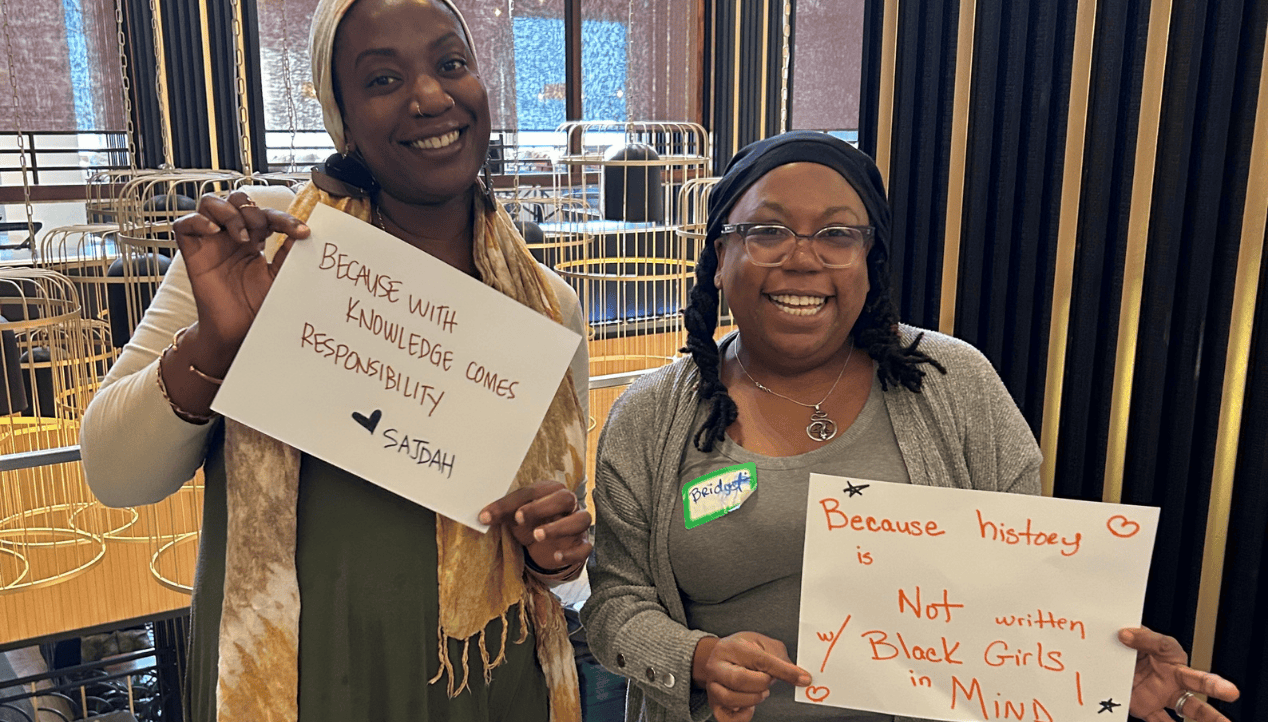
Image: Sajdah Asmau (left) and Bridget D. Haney (right), 2024 Public Voices Fellows with the National Black Child Development Institute in collaboration with The OpEd Project, at NBCDI’s 2024 National Conference in Atlanta, October 2024