This Dispatch reflects on an IHP-funded project that maps the evolution of religious and spiritual life at the University of Michigan, tracing its transformation from a predominantly Christian institution to a vibrant tapestry of diverse faiths and worldviews. By surfacing key historical events, policy shifts, and influential forces like the GI Bill and U.S. Immigration reforms, the study highlights pivotal moments in campus religious diversification. With the help of an Inclusive History Project Research & Engagement Fund grant, a team of graduate and undergraduate students, faculty, and staff at the Office of Religious, Secular and Spiritual Life (RSSL) put together an interactive timeline showcasing important occasions in the development of faith spaces on campus. Through multi-method research, including archival exploration, oral histories, and collaboration with ongoing projects on Jewish and Muslim Student life, we bring to life an ongoing account of what religious life has looked like at the University of Michigan.
A Dispatch From Somewhere Sacred
By Omprasadham, PhD Candidate in English, UM-Ann Arbor
In 1939, the Student Religious Association sent out a memo from Lane Hall. It was addressed to the Ann Arbor Council of Church Women and written on behalf of the Office of Students of Other Lands (that’s what they used to call international students like me, way cooler name in my opinion). The letter made a rather simple request: “This year, among the more than 600 students from at least 50 different countries, there are a number of newcomers, feeling lonely and strange in a foreign land… but when they come into your home, you will try to make them feel at home. Encourage them to ask questions, show them any gadgets they may be interested in, ask them questions about their home and family.”
What is the role of religion at a secular university? Polling data shows that Americans are less religiously identified than they have ever been, and despite online rumblings about Gen Z religious revivals, there has yet to be a notable uptick in overall religiosity on college campuses across the country.¹ The University of Michigan was established in 1817, co-founded by Catholic priest Father Gabriel Richard and Presbyterian minister John Monteith as the “Catholepistemiad” (a name so etymologically convoluted that Governor Lewis Cass would instead refer to it as “Cathole-what’s-its-name”²). This early ecumenical foundation paved the way for a robust and unwavering commitment to interfaith engagement. While President James B. Angell (for whom Angell Hall is named) eventually abolished weekly chapel attendance and the required Christian coursework, religious activity on campus lived on in the newly formed Student Christian Association (SCA).
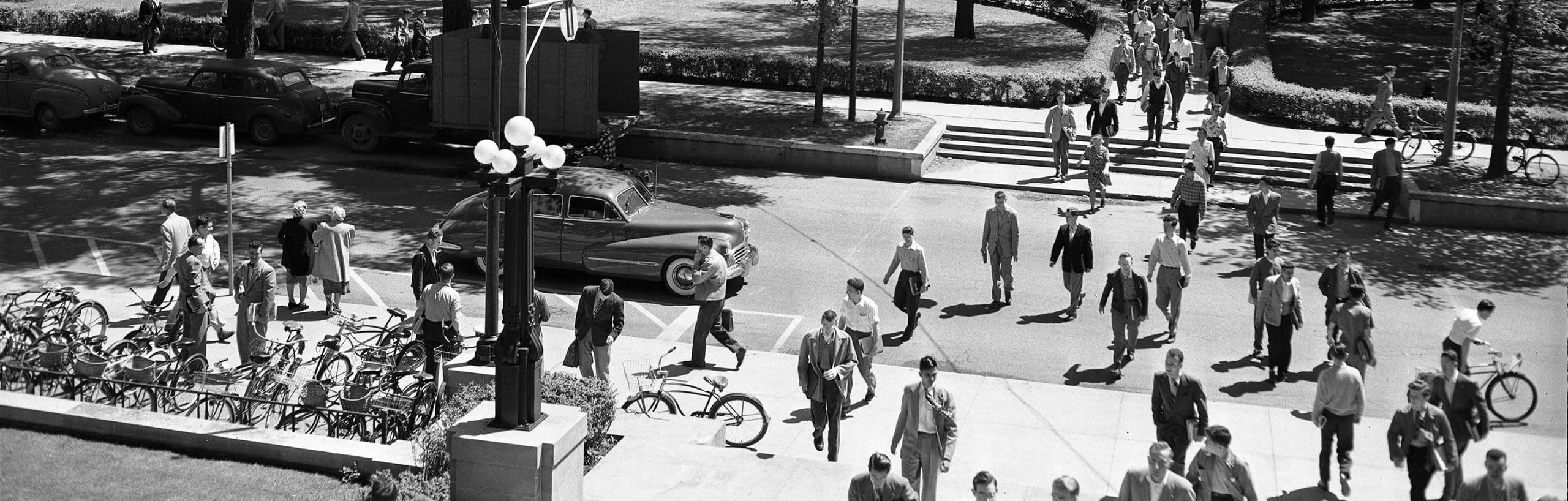
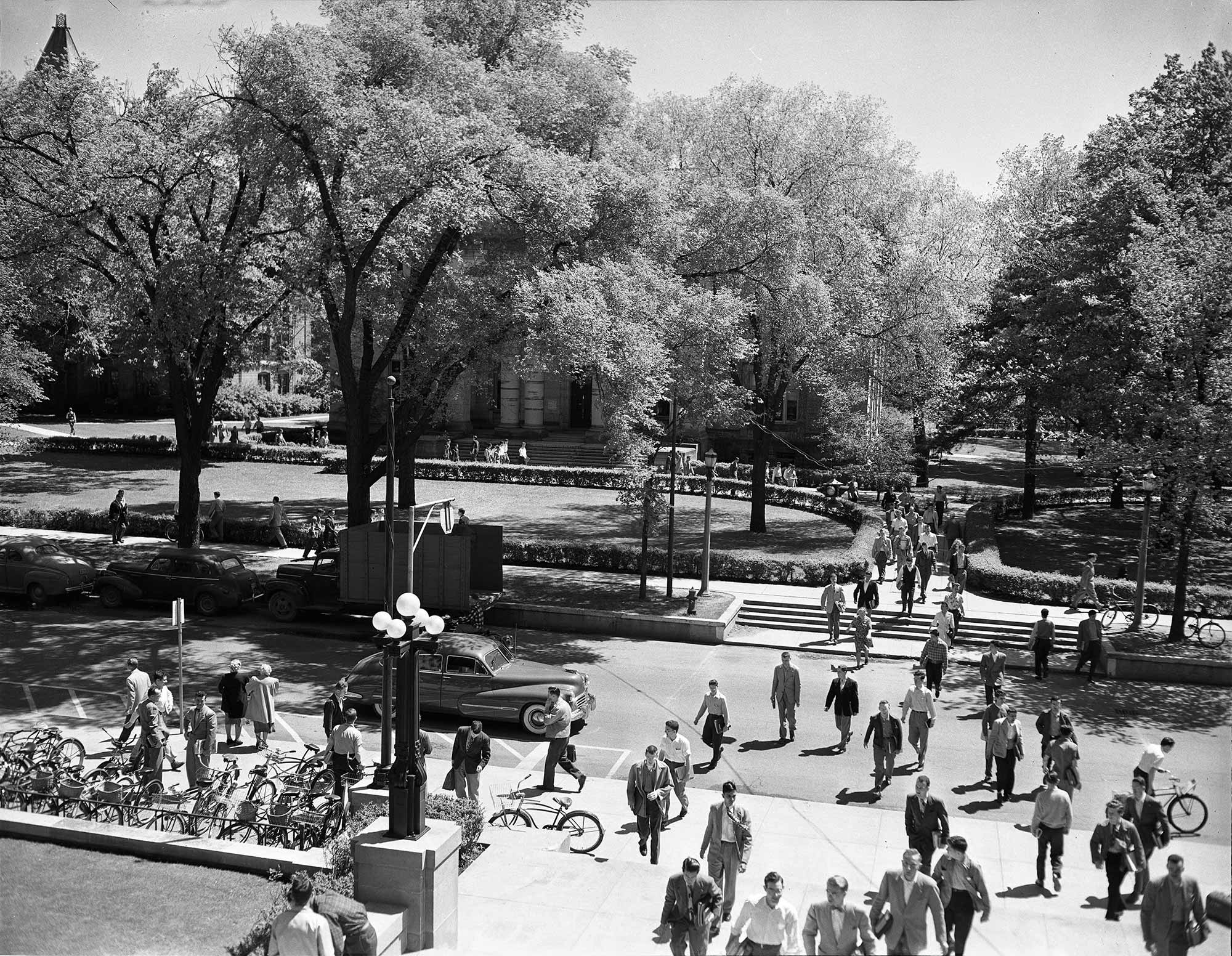
This is what is hard to grasp about religious life from a contemporary lens: religious life wasn’t just a part of the university; it subtended every part of the university. The SCA was richly involved in student programming, laying the foundations for many of today’s well-known (and now secular) student services. The legacy of Student Life at the university draws from initiatives and events planned by Religious Life in the university’s past, as the purview of faith orgs stretched further than the institution itself could manage. Consider the Freshman Rendezvous, an annual tradition where the entire freshman class would go to a retreat led by upperclassmen as an official transition from high school to college. While organized and funded by the SCA, archival documents like sign-up sheets and rosters indicate provisions were made for Jewish and Catholic students to attend their own religious services over the course of the weekend.
The presence of Jewish students is particularly important because in 1926 the Hillel Foundation was established, creating a home for Jewish life on campus against a backdrop of quotas and exclusion at other elite institutions. By 1937, the Student Religious Association (SRA, the SCA’s now-official university successor) had clauses in its constitution requiring student representation from a variety of religious traditions, including those of (what were then called) “Eastern Faiths.” As Michigan saw an uptick in Arab and North African immigrants, it was the Muslim Student Association (founded in 1963, making it potentially the oldest MSA in the country) that provided resources and support for them to feel at home in the community.
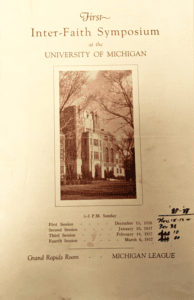
SRA Program, Bentley Historical Library, 1936–1937. SRA programming, while mostly Christian, included interfaith aspects, particularly in conferences and workshops focusing on Hinduism, Buddhism, Judaism, and more.
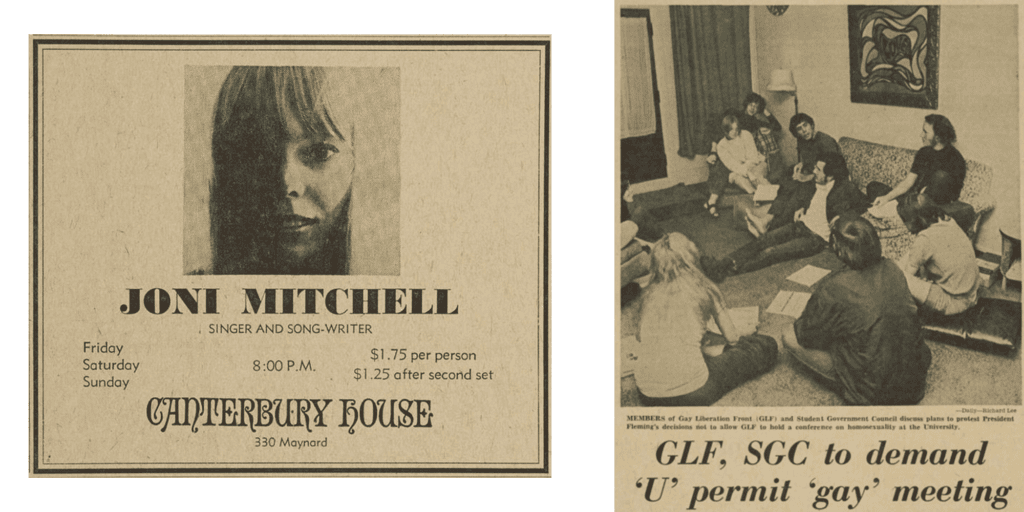
Interfaith programming was a throughline of religious life at Michigan, from our first interfaith symposium in 1936 to widely hosted anti-discrimination discussions during the Civil Rights era. This is no surprise: religious life was richly involved in political and social justice movements across the decades. During World War II, the head of the Office of Religious Affairs (ORA) Ken Morgan led the charge on anti-war protests as an extension of his Quaker faith. When the university refused to allow the Gay Liberation Front to host their meetings on campus in the 1970s, queer-affirming student ministries stepped in to provide spaces of their own. Religious life was not separate from intellectual and cultural life either. It is through the various iterations of the Office of Religious Life that the university hosted the likes of Reinhold Niebuhr, Bertrand Russell, Jesse Jackson, Alan Watts, Angela Davis, and Said Ramadan. In 1962, the ORA invited the Reverend Dr. Martin Luther King Jr. to speak at Hill Auditorium, where he brought the house down advocating for civil disobedience at a time when university leadership was trying to quell student activist movements. Religious organizations hosted both activists and artists; you can still find Joni Mitchell’s recording Live at the Canterbury House (a longstanding base of operations for Episcopal Student Ministries) among her best-selling vinyl albums.
(Left) The Michigan Daily / Joni Mitchell Archive, 1967. An advertisement for Joni Mitchell performing at Canterbury House in 1967. This recording became her live album “Live at Canterbury House.” (Right) Richard Lee, The Michigan Daily Digital Archive, 1970. Jim Toy went on to serve on the board of the Guild House, helping guide queer religious programming for years to come.
Even as religious life has ebbed from its position as a core fixture of administrative and academic university operations, it continues to play a vital role in how students and faculty experience life on campus. From a growing number of accommodations in dining halls, bathrooms, and syllabi, religious tolerance continues to be a core value of the university. Even as the Office of Diversity, Equity and Inclusion (DEI) was closed at the University of Michigan due to external pressures, religious life continues to provide community and support for students from minoritized backgrounds. Religious life is one of the main ways students get connected to Ann Arbor townies as they all congregate in places of worship, one of the main ways students volunteer and participate in food justice and community support initiatives, and one of the main ways students remain connected to parts of their identity, even when they are far from home.
Sitting in the Bentley Historical Library, going through decades of boxes from the Office of Ethics and Religion collection, I continue to be struck by just how rich and multifaceted the story of faith has been throughout this university. In constructing a timeline of the history of institutional religion at the University of Michigan, our team reached not only back into the past but laterally across the present, connecting with different parts of the campus community ranging from MDining and the Ginsberg Center to the Association of Religious Counselors (ARC). We found that in trying to tell the histories of faith communities at our university, many of these communities had already been telling their own stories. This gave us a chance to spotlight their own collections, their own IHPs, their own accounts of their trials and triumphs. Looking at hundreds of years’ worth of pamphlets and posters, newspapers and notices, I could see how the work we do today builds on centuries of work done by these faith communities. We can see so much farther for having stood on the shoulders of those who came before us.
It is no coincidence that the Office for Students of Other Lands was housed under religious life. Religious life has always been a refuge for those far from home, for those feeling “lonely and strange in a foreign land.” Over 80 years after that memo was sent out, I came to this country, and when I did, it continued to be women in faith communities who made me feel at home. It was wives and mothers at church who asked me how I was doing, how much I must miss home, and whether I had somewhere to go on Thanksgiving. While the role of religion looks different than it did 200 years ago when the university was founded, religious, spiritual, and faith communities continue to connect us to those who came before—and to those who are willing to welcome us now.
Explore the Mapping a Multi-Faith Journey timeline to learn more about how faith, spirituality, and religion have been a part of the rich and robust experience of student life at the University of Michigan for over 200 years.
1. Cox, Daniel A. “Generation Z and the Future of Faith in America.” Survey Center on American Life, 24 Mar. 2022.
2. Rubenstein, Bruce A., and Lawrence E. Ziewacz. Michigan: A History of the Great Lakes State. 5th ed., John Wiley & Sons, 2014