


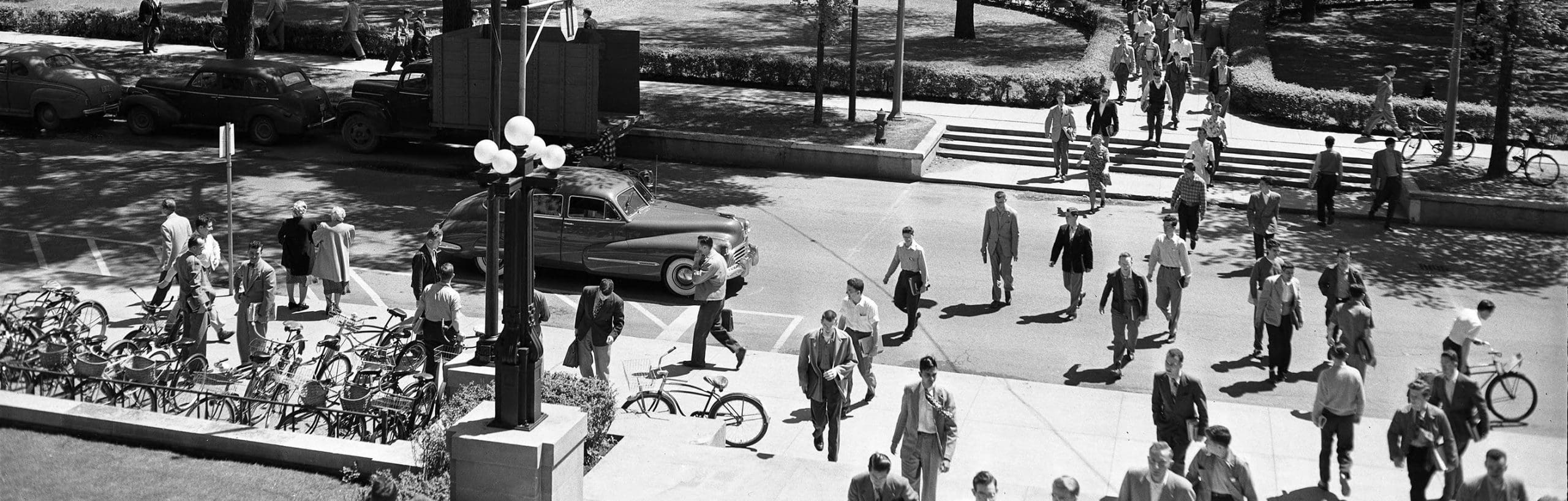
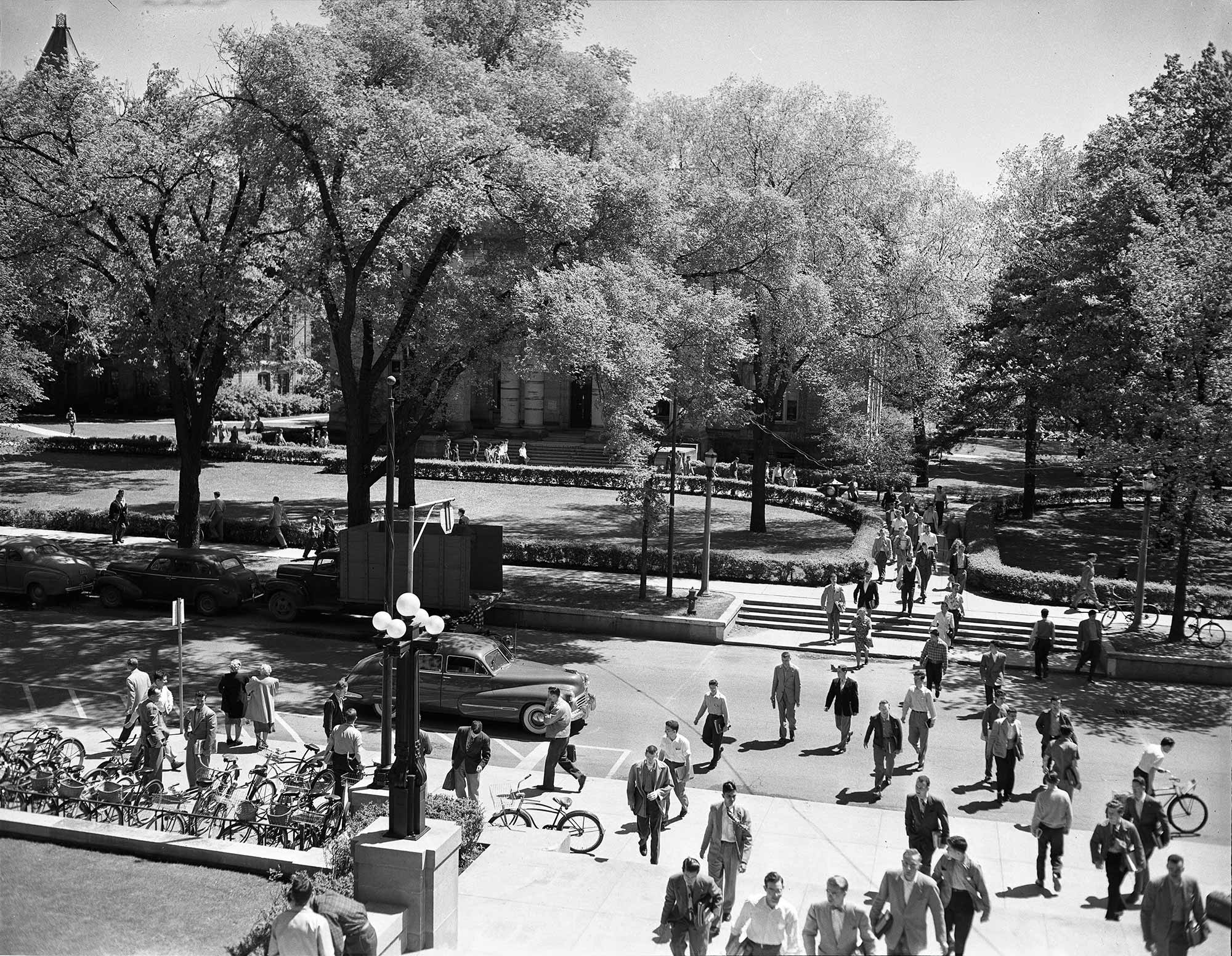

Blueprints of Power: The University and Urban Renewal in Flint explores how UM-Flint’s downtown campus emerged from the ambitions of city leaders, university administrators, and policymakers amid the displacement of predominantly Black neighborhoods through urban renewal—a mid-20th-century government program aimed at redeveloping “blighted” areas. The exhibition explores the complex tensions between redevelopment, civic vision, and the human cost of “progress” in Flint, inviting visitors to consider who benefits from development and who bears its burdens. Blueprints of Power: The University and Urban Renewal in Flint raises questions about power, community, and accountability, highlighting how decisions about city planning and university growth shaped both the physical and social landscape of the Flint we know today.
The exhibition is split into two sections. The first is a mobile installation that traces how the University of Michigan-Flint came to occupy its present home along the Flint River. Before 1971, the university—then known as Flint Senior College—shared space with what is now Mott Community College. Its move downtown was not simply a matter of growth or geography but the result of intersecting ambitions: those of business leaders seeking to revitalize the city’s core, university administrators envisioning expansion, and policymakers wielding the tools of urban renewal. While some celebrated the project as progress, others pointed to the neighborhoods left behind, where disinvestment and delayed action deepened the hardships faced by mostly Black, working-class families who had been adversely affected by earlier waves of urban renewal.
The second section focuses on The Flint Spokesman, which played a key role in the research for the Blueprints of Power exhibition. This section is not currently on view at the University Pavilion; however, it was exhibited during the winter term at the UCEN Gallery. The Flint Spokesman was a local newspaper that was founded in 1946 and later revived in the early 1970s and offered unfiltered perspectives from Black community leaders. The paper played a crucial role in documenting issues such as police brutality, Black politics, labor, and community organizing, including the work of the Urban League of Flint. Under editor and publisher Tom Terry, its radical and outspoken writing helped shape community discourse until the mid-1970s, when it shifted toward more moderate political commentary and a more professional layout. After the paper closed in 1980, Concerned Pastors for Social Action launched The Flint Courier, which continues today. Digital copies of The Flint Spokesman are accessible through the University of Michigan Library Digital Collections.
Blueprints of Power: The University and Urban Renewal in Flint is a product of the Inclusive History Project’s Urban Renewal and the University of Michigan-Flint project site. The exhibition is led by Callum Carr-Marquis and Benjamin Gaydos with the assistance of Nalani Duarte, Catie Cunningham, Melody Gorishek, Megan Pellegrini, Asya McAlindon, Claire Perry, Michael Miller, Jennifer Junkermeier-Khan, Lisa Lapeyrouse, Jennifer Brady, Thomas Henthorn, John Jenkins, Jacob Jones, Rodney Brown, Davarian Baldwin, and Earl Lewis.
All photographs included in the exhibition are courtesy of the Genesee Historical Collections Center at the Frances Willson Thompson Library, University of Michigan-Flint. The exhibition is co-presented by the Inclusive History Project, the Genesee Historical Collections Center, and the Art & Art History Program.
Questions? Email us at [email protected].