Our series of IHP Dispatches opens up our research and engagement processes by narrating the behind-the-scenes work involved in digging into the university’s history, with stories told in the voices of the people doing that work. Read our second installment on the history of Hill Auditorium on listening to its overlooked past of protest below.
A Dispatch from Hill Auditorium
By Emily Lyon, IHP Research Fellow
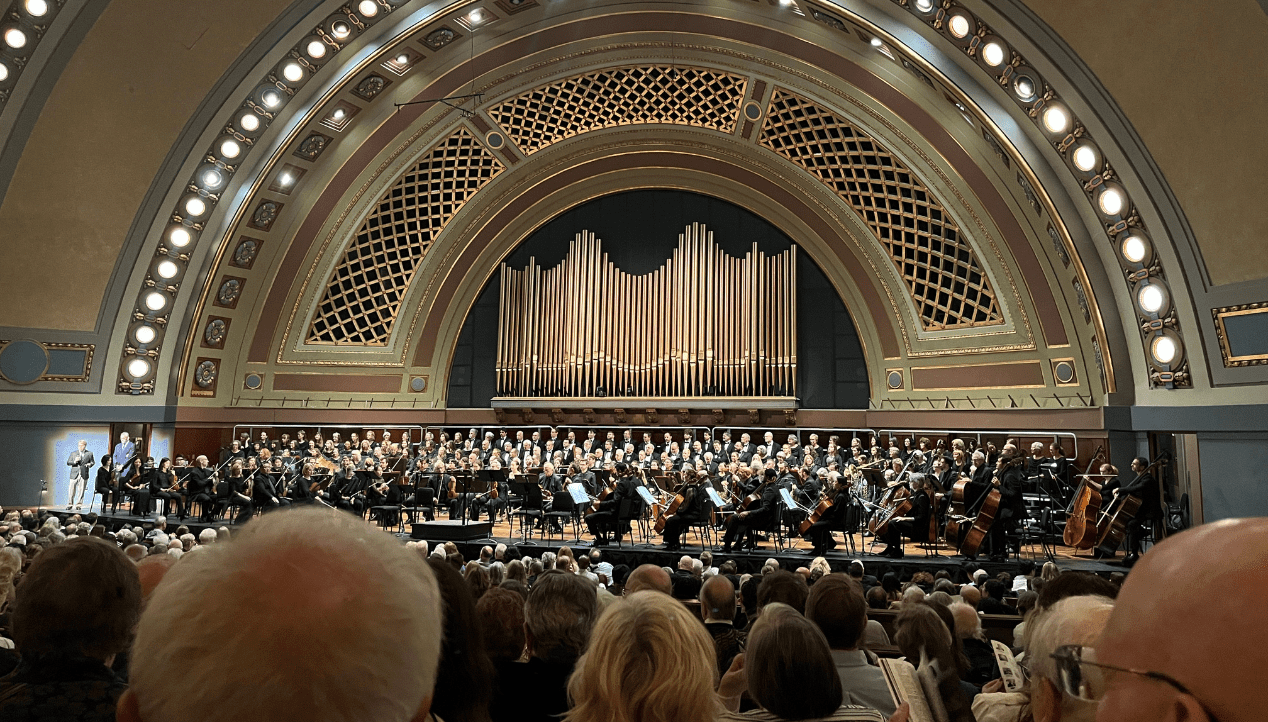
On a Friday night in late September, with the energy and excitement of a new academic year still in the air, the research team for the IHP’s Hill Auditorium project had the opportunity to attend a performance at Hill. Although we had spent the past months researching Hill’s history, this was the first time most of us saw the building come alive during a performance. We had chosen Giuseppe Verdi’s Requiem performed by the Detroit Symphony Orchestra and presented by the University Musical Society (UMS) because the piece has been performed at Hill many times.
The entire evening offered each of us the chance to consider how the auditorium’s history shapes our experience of the building today. The team’s undergraduates—Alex Hsu, Audrey Rosenberg, Charles Milne-Home, and Courtney Mims—had been tracking any and all events at Hill since the 1910s in the digital archive of The Michigan Daily newspaper. Musicology graduate student Paige Carter Dailey had spent the summer diving into the university’s archives at the Bentley Historical Library. I had joined the project in mid-July and spent most of the summer catching up on and reviewing all of their hard work and thinking about how we would connect and further explore all of the leads they had uncovered.
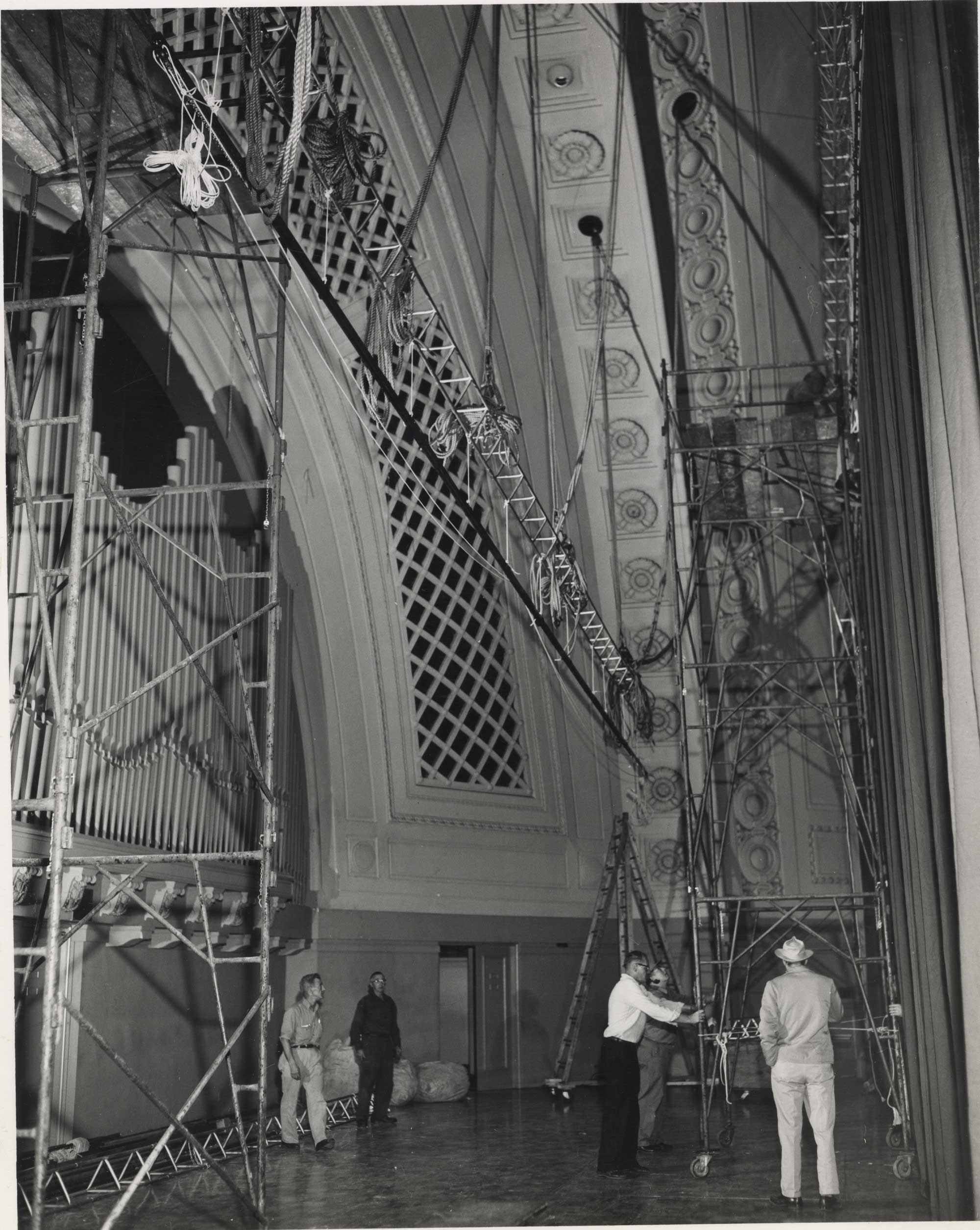
Approaching the building that evening, we were greeted by a large crowd of excitedly but quietly chatting groups in the plaza in front of the entrance, just as so many of Hill’s guests before us had experienced over the decades. Once we entered through the front doors, ticket takers directed us to pull up our tickets on our smartphones (unlike many of Hill’s earlier guests) and then pointed us inside. Under the warm glow of the lobby lights, a crush of people moved in different directions, heading toward bathrooms, water fountains, coat racks, and into the theater. As we entered the auditorium itself, ushers guided us to our seats as we looked up and around, admiring the carefully restored medallions on the parabolic ceiling, the hundreds of lights that lit up the room, and the original organ shining behind the seats on stage for the chorus and orchestra. Feeling the anticipation of the crowd for the evening’s performance, we talked amongst ourselves while flipping through the program book and remarked on the connections with the past that came to us as we sat in our red velvet seats.
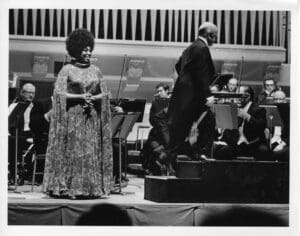
In the snippets of conversation I heard from people seated nearby as they greeted old friends and discussed their past favorite events, smiling, laughing, and settling into familiar routines and conversations, I could tell that this was a place with lifelong and important memories for many of the patrons. I am new to U-M and don’t have those memories, but my thoughts went to the photographs of all the people, events, and performers I had seen from across Hill’s history in this very space. I knew, for example, that groundbreaking performers like soprano Leontyne Price had performed Verdi’s Requiem in 1960 in one of her many appearances at Hill. But classical music performances were not the only important histories that happened at Hill.
Some of these histories were quieter than others in our experience of the performance. Since its opening in 1913, the architects, university officials, and donors who designed Hill intended for it to serve all members of the university community and the greater good, both on and off campus. But this desire often has come with qualifications. From the moment Hill opened in 1913, university officials sought to mandate who would be heard at Hill, especially around the issue of political speech. In 1915, the Regents approved Theodore Roosevelt’s appearance at Hill so long as it was on a “non-political subject.” In 1919, when students petitioned to allow debates around the League of Nations, the Regents banned any discussion “in view of the political aspect of this question at the present time.” The Daily published multiple articles throughout March, April, and May around this silencing of “political” speech at Hill. But the Regents said again in December of 1920 that “the use of Hill Auditorium may be granted to student organizations for lectures or addresses by prominent men…under guarantee that during such addresses there shall be no…advocacy of the subversion of government or of the state” and that “under no circumstances shall the building be used for political speeches or purposes.” Other former U.S. presidents had to abide by these rules–when William Howard Taft came to speak that year, he was not allowed to discuss the League of Nations, though he could address the topic of “Capital, Labor, and the Soviet.”
These past decisions defined what types of people and types of discussions were welcome at Hill. They still echo today. Although Hill is open to all, it is usually only unlocked during events, and a visitor typically needs to buy a ticket to gain entry. Despite best efforts to welcome all into the space, once a visitor enters through the front doors, they are faced with a series of unwritten and unspoken rules around how to behave that range from what to wear to how to move through the building to when to clap.
The entire research team was aware of the norms shaping our experience. Some of us felt underdressed–as one of the research assistants pointed out to me, although the UMS website does not list a dress code and welcomes everyone to express themselves, there is an unspoken set of expectations for dress at these types of performances. Others felt uncomfortable as we realized we had immediately begun to participate in the unspoken performance etiquette rules–speaking in hushed tones, trying to keep still and focused, triple checking that we had remembered to set our phones to silent, responding to the music in particular ways. These norms became apparent once the performance began and we all became aware of just how much noise shuffling, sneezing, or coughing could make in that space as we shifted in our plush, but cramped seats. I realized I had no idea how programs for this type of performance (or classical music in general) were organized. As the soloists and choir began to sing the lyrics in Latin, I desperately (and as silently as I could) flipped through the pages to find our place in the program so that I could follow along with the English translation. I finally located our place in the program sometime in the second or third movement when I realized that, although the lines were only printed once, the singers often repeated the lines.
Our research has also highlighted repetition—that different groups have repeatedly codified and contested these spoken and unspoken rules across Hill’s past. For example, in March of 1935, students again protested after the university banned John Strachey, a British politician affiliated with the Labour and Communist parties, from appearing at Hill. Strachey had been invited by the National Student League (NSL), whose platform at U-M included demands for a reduction of college fees, the abolition of the R.O.T.C., social and political equality for racial minorities, and fighting against fascism. The university’s Committee on Lecture Policy had ruled that the NSL would not be allowed to host the lecture because they were not “responsible” enough.
Reactions from students, faculty, and alumni around this incident were mixed, but many signed petitions, sent letters to the editor in the Daily, and wrote directly to then U-M President Alexander Ruthven expressing outrage at what they saw as a violation of freedom of speech. Some argued that Hill was not a public hall, but rather university property; others argued that if the university wished to continue receiving taxpayer dollars, it should allow for the expression of a diversity of opinions at its auditoriums. In the same 1934-1935 school year, the NSL also organized protests before the Georgia Tech football game to demand that Willis Ward, a Black Michigan football player, be allowed to play and organized anti-war strikes in the spring. President Ruthven informally expelled four students in the NSL by asking them not to return the following year because they were not “the type of student wanted on the University campus” and because of their “perversive” “interference” with university work. By the end of the 1930s, the Regents decided that university auditoriums would primarily be used for university purposes and that formally recognized student organizations could use university spaces only if they did not “urge the destruction or modification of our form of government, by violence, or other unlawful methods” or speak in support of “any political party or faction.”
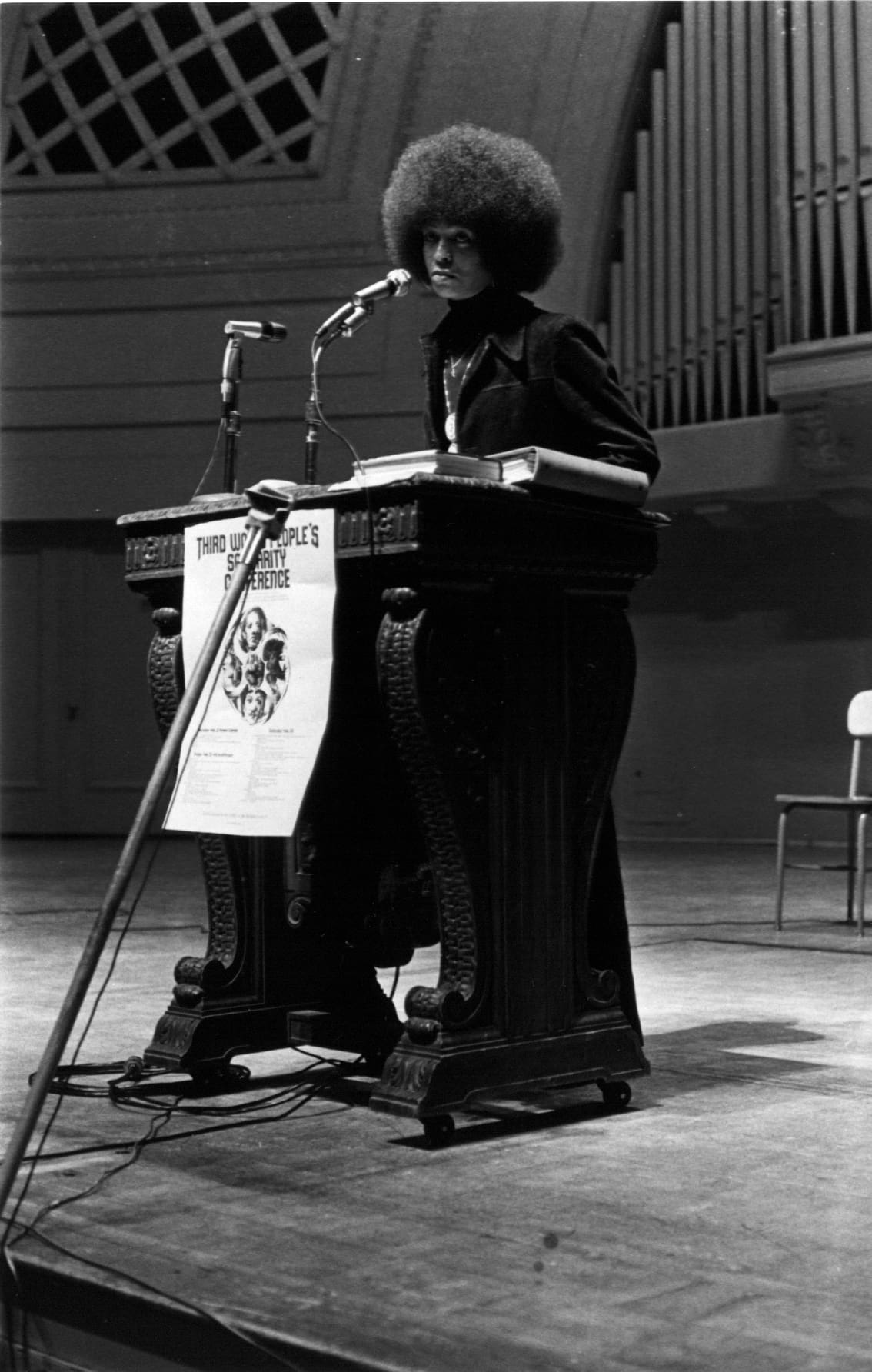
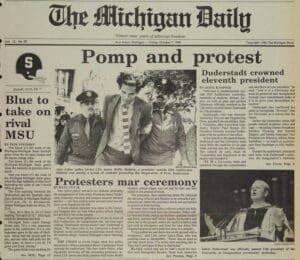
Although the history of classical music performance at Hill had come alive for us the night of our show, our experiences there did not speak to this history we have found in the archive. Nor did it point to the longer legacies of students using Hill as a site of struggle and protest heard across the twentieth century. In 1947, after President Ruthven banned the Michigan Youth for Democratic Action from campus, students protested and repeatedly demanded to use Hill for a forum on academic freedom planned by the Student Town Hall organization. In the 1960s and 1970s, students and activists organized anti-war protests, teach-ins, and sit-ins at Hill. In 1970, the Black Action Movement began its protests in front of Hill and interrupted an honors convocation within the auditorium. Although it is still unclear why, the university began centralizing the process for and began restricting who could schedule events in all university auditoriums in the late 1970s and early 1980s. But students continued to speak out at Hill. In 1980, graduate workers demanded the university negotiate their contract. In 1988, students protested outside President James Duderstadt’s inauguration, objecting to new restrictive protest policies and asking the university to define a clearer “diversity plan” that would address the racism Black, Asian, and Native American students have faced. This 1988 protest resulted in arrests and hospitalizations after a confrontation with Ann Arbor police.
This longer history of collective action and student protest is not visible when attending a performance in the building today: it’s unspoken, just like many of the rules that shape how we interact with the space. But these histories have shaped the space, and they continue to reverberate today. Uncovering the fuller past of Hill Auditorium can help us examine these norms and tell a new story–one that remembers and elevates a more expansive range of stories and people who have made Hill Auditorium what it is today.
Were you part of a protest or political event at Hill? Did you work backstage or front of house? Were you part of one of the student organizations that held events at Hill? The research team for the IHP’s Hill Auditorium project is currently seeking untold stories and lesser known histories of Hill as part of its participatory, collaborative research process.