The fourth installment in our series of IHP Dispatches is written by Alyssa Paredes, assistant professor of anthropology at UM-Ann Arbor. She recounts a trip the team from the ReConnect/ReCollect: Reparative Connections to Philippine Collections at the University of Michigan project made to the southern Philippines in July 2025. Professor Paredes positions the team’s sharing of copies of materials from U-M’s vast collections of Philippine materials, their dynamic exchanges with local collaborators, and the knowledge-sharing made possible through those exchanges as part of the project’s broader efforts to build and maintain reparative connections with descent communities. ReConnect/ReCollect joined the IHP as an affiliate project site last year to continue their work, which includes this community consultation.
A Dispatch from the Southern Philippines
By Alyssa Paredes
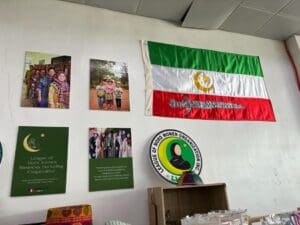
The ReConnect/ReCollect team landed in Cotabato City in the southern Philippines on a sunny morning in July, narrowly escaping the torrential rains of Manila. Our ten-person group, along with the other passengers of the flight, filled the modest airport building, still halfway through its construction. Over the crowd, I could not help but notice an unfamiliar flag–bands of green, white, and red emblazoned with the seven-pointed star, crescent moon, and kris blade–displayed overhead. I learned later that the flag of the Bangsamoro Autonomous Region of Muslim Mindanao was adopted only six years ago.
The flag of the Bangsamoro Autonomous Region of Muslim Mindanao.
The flag was only one among many other symbols of the historically significant transition currently underway in the region. Cotabato City in the Province of Maguindanao is located within the Bangsamoro Autonomous Region of Muslim Mindanao, hereafter BARMM, the only region in the predominantly Christian Philippines populated and governed by a Muslim majority. BARMM was inaugurated in 2019, after the congressional passing of the Bangsamoro Organic Law the year before. The recent development marked the culmination of decades of tense negotiations between the government of the Philippines and the Moro Islamic Liberation Front. For forty years, Muslim secessionists in the southern Philippines have aspired for sovereignty from the nation-state based on claims of independent statehood dating back to the 15th century. With the passing of the Bangsamoro Organic Law, government officials, lawmakers, and everyday citizens alike are hopeful that the region is entering a new era of peace, democratic process, and state building. One of the great challenges that BARMM faces in its transition process is reclaiming its people’s own voice in the writing of the region’s cultural history.
Our visit was motivated by a desire to play a role in that process. Since 2021, ReConnect/ReCollect, a multidisciplinary collaboration between UM-based archivists, museum curators, and scholars, has traveled to the Philippines to conduct research and community consultations across the archipelago, sharing copies of the university’s collections with descent communities in the process. The project came together in recognition of the large holdings of Philippine materials at U-M, many of which were acquired by U-M archaeologists, zoologists, and botanists who conducted extensive expeditions in the islands in the late nineteenth and early twentieth centuries. Through the community consultations, ReConnect/ReCollect members have sought to restore ethical curatorial practices, rebuild meaningful ties with communities of origin, and advance inclusive and corrective academic research. Our trip to Mindanao in the summer of 2025 represented a continuation of this work, which took the team to the regions of Luzon and Visayas in previous years.
The decision to make the trip was no small matter. Cotabato City, like many other parts of Western Mindanao, has been typecast in the public imagination as a landscape of political disorder, social backwardness, and economic stagnation, pervasive narratives that have largely discouraged international visitors against travel. Many of these stereotypes are espoused by folk who have neither been to Mindanao nor have considered the profound impact of dispossession on its Indigenous Peoples. They belie the cultural richness of the region and the resilience of its peoples, elements of local life that we had the privilege to witness ourselves.
Our host was the Bangsamoro Museum, a cultural institution managed by the Bangsamoro Commission for the Preservation of Cultural Heritage (BCPCH) that links cultural education to the bureaucratic reforms currently underway at BARMM. Stepping in the modest government building for the first time, the museum seemed to me not only a repository of musical instruments, woven fabrics, and ceremonial urns, but also a dynamic space for historical memorialization and storytelling. This was made clear by the prominent display of archival documents on the walls, just beyond the photographic images of the Siege of Marawi.
On the day of our community consultation, we were warmly received by Senior Minister Mohammad S. Yacob and Member of Parliament Hon. Abrar J. Hataman, as well as the BCPCH leadership, staff, researchers, and students. Our event began with the singing of the Bangsamoro Hymn, a moment that stands out in my mind. Just as I hadn’t seen the new flag before arriving at the airport, I’d never heard the region’s new anthem before and was moved by its poignant words:
Rise up from our damned past. Conquer the hindering dangers. Promises made in heart and by faith become comfort to our youth. Bangsamoro is triumph, the fruit of our toil, blood, and life. Peace and justice are now within our grasp. Alhamdulillah, alhamdullilah (Praise be to Allah). God bless the Bangsamoro.
Salem Y. Lingasa, chairperson of the Bangsamoro Museum and commissioner of the BCPCH, was among the first to speak. “There is an injustice being done to our history. Only ten percent of the narrative is from us,” he said, and mentioned the commission’s struggles with the dearth of materials available to tell this history, with many records hidden away in institutions in Manila or abroad. “Cultural heritage is not a side project for us. This is a responsibility. We want to talk about our history in a way that is healing.” The leaders of the ReConnect/ReCollect project, Deirdre de la Cruz, Arthur F. Thurnau Professor of history and Asian languages and cultures, and Ricky Punzalan, associate professor of information, responded by introducing the project and its goals of connecting directly with cultural communities, contextualizing and correcting colonial-era descriptions, and activating U-M’s archival and museum collections through greater access.
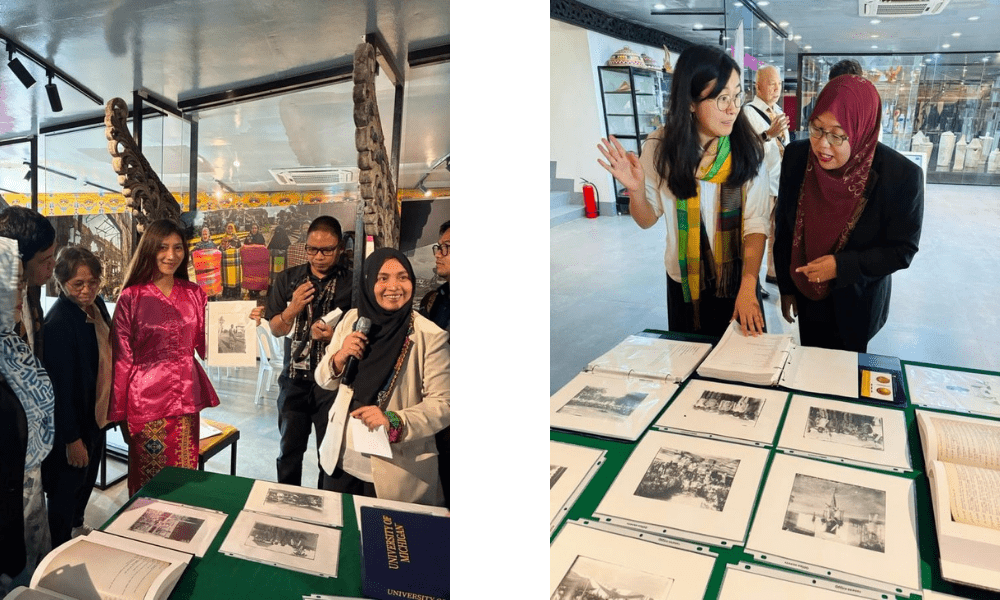
A highlight of the consultation session was the presentation and turning over of digital and printed photographic materials from the U-M Museum of Anthropological Archaeology (UMMAA) and collection finding aids from the Bentley Historical Library. As has become practice for ReConnect/ReCollect, we laid the materials out on a table and viewed them together with our local collaborators. Jim Moss, collections manager at UMMAA, and I had prepared a representative sampling of early 20th-century photographs of the Moro peoples from the Dean C. Worcester collection at UMMAA. Community members examined the photographs, identified individuals they recognized as kin, and engaged us in conversation about the meaning and value of the images. Esnaira Salem, senior history researcher at the Bangsamoro Museum, told us that photos of old buildings were rare and particularly useful for recognizing historical landmarks as worthy of preservation. Local participants were also keen to identify inaccuracies in the materials, details that Director Alexis Antracoli and Assistant Archivist Gideon Goodrich of the Bentley Historical Library collected to take back to Ann Arbor. For example, a member of the Indigenous Teduray tribe in the audience picked out one photograph that had mislabeled her group as “Teruriya”; she was, however, delighted to see the subject in the photo donning the same dress she herself was wearing. Another photograph depicted a dance that participants did not recognize, raising questions as to whether American colonial officials had instructed the photographed subjects to pose in inauthentic ways. It was a lively session that, to me, embodied the core thrust of what ReConnect/ReCollect hopes to accomplish through reciprocal knowledge sharing.
(Left) A Teduray community member holds up a photograph of a Teduray woman from the early 20th century. The photograph is from the Dean C. Worcester Collection, housed in the University of Michigan Museum of Anthropological Archaeology. (Right) Alyssa Paredes, assistant professor of anthropology at U-M, and Esnaira Salem, senior researcher at the Bangsamoro Museum, looking over the Bentley Historical Library finding aids.
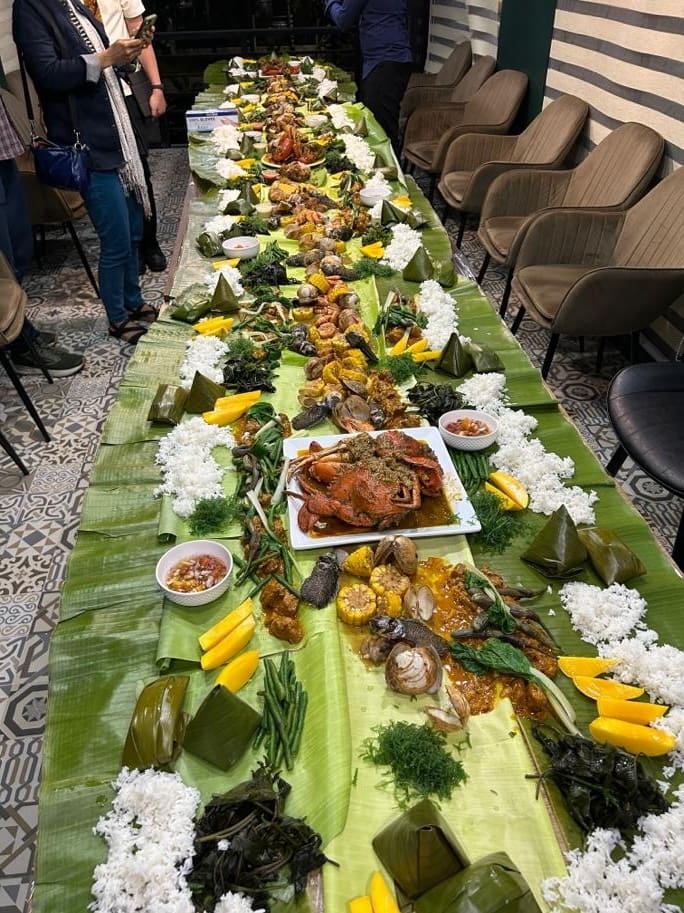
Our day ended with a sumptuous banquet–a traditional Filipino kamayan (“by hand”) feast–generously prepared for us by our hosts. Bright green banana leaves lined a long table piled high with grilled shrimps, clams, fish, seaweed salads, mangoes, dipping sauces, and steamed rice. The centerpieces were plates of giant freshwater crabs, cooked in a spicy curried sauce, which had been caught in the estuaries near the Grand Mosque of Cotabato (Sultan Haji Hassanal Bolkiah Mosque) the day before. Everyone gathered around the table and dug in with their hands, a symbol of intimacy.
I had the pleasure of sitting next to Esnaira. We spent the evening chatting about her love of local coffee, her desire to pursue an advanced degree abroad, and her hopes to someday visit Ann Arbor to view the rest of the Philippine collections. At one point, she turned to me to say, “A lot of our archival materials exist in offsite institutions. Many of them are written by outsiders of BARMM. This is the first time someone came to us.”
Following the visit to BARMM, our travels took us to two other areas of Mindanao: Malaybalay City in Bukidnon Province, where Indigenous Lumad faculty and students of Bukidnon State University were in the process of revamping their Indigenous Studies curriculum, and to Davao City in Davao del Sur Province, where efforts to set up a new Davao Museum in the Ateneo de Davao University campus were underway. The ReConnect/ReCollect team left Mindanao feeling that we had played a small role in locals’ efforts to rewrite their own history. But perhaps even more so, we left having learned something invaluable from our new friends. Ricky Punzalan stated it best over our discussions with the Bangsamoro Museum staff: “I learned something new from you–the concept of cultural justice.”
A kamayan feast.
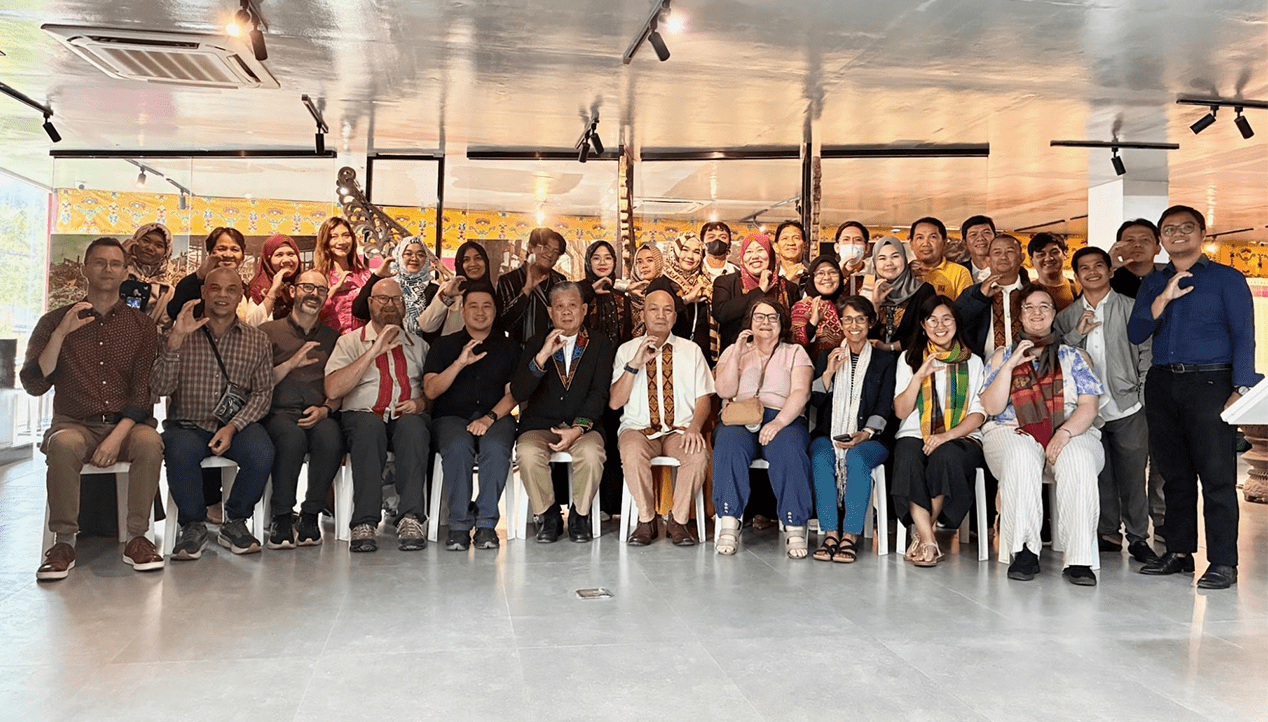
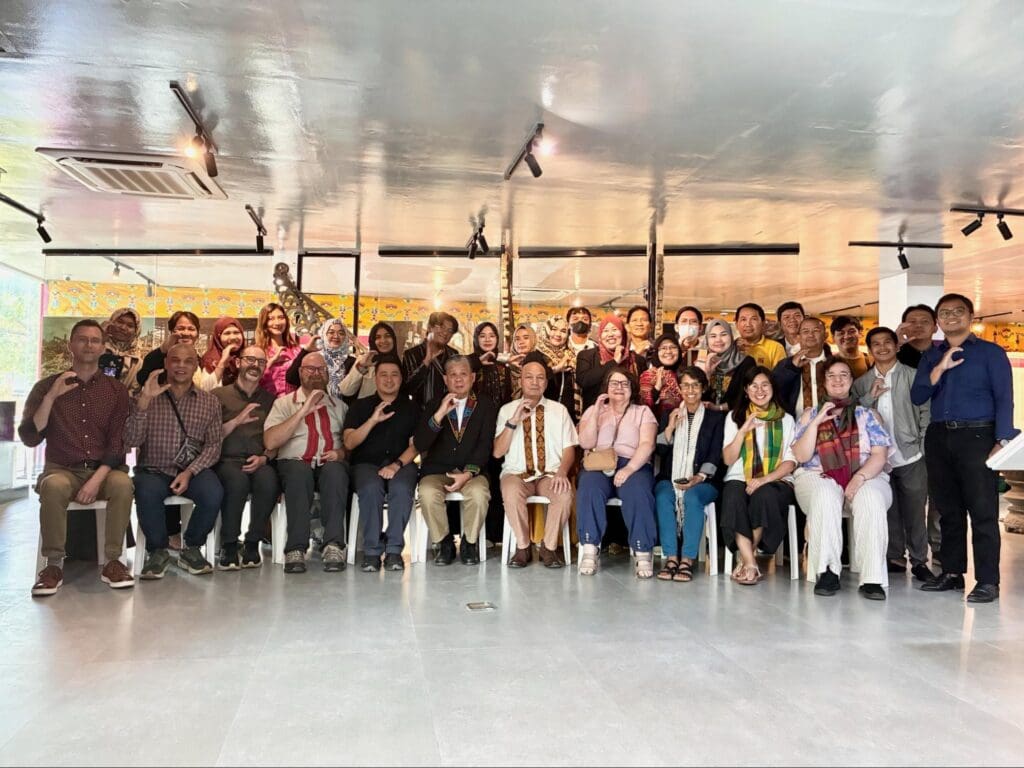
“C is for culture.” A group photo of the community consultation at the Bangsamoro Museum, Cotabato City.