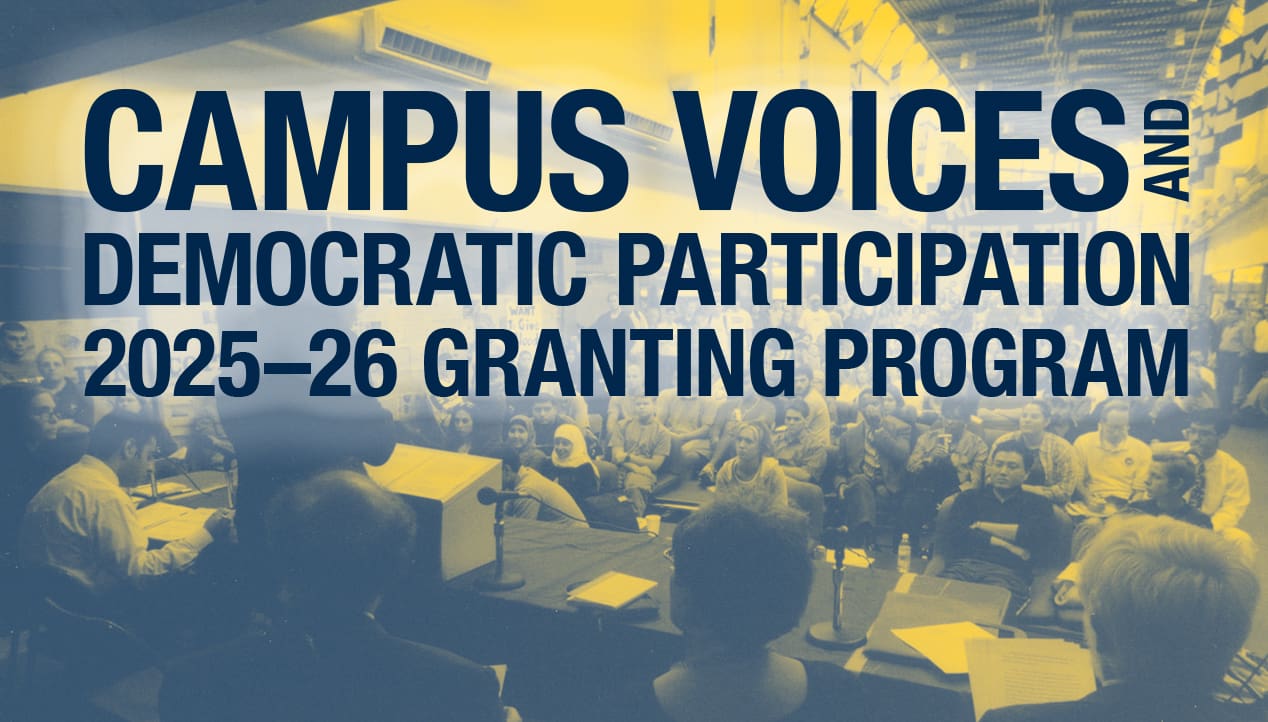
2025-26 Granting Program: Campus Voices and Democratic Participation
Inclusive History Project
Apply by October 30
For its 2025-26 IHP Research & Engagement Fund and IHP Teaching Fund competitions, the IHP invites proposals for projects and courses that consider how members of the University of Michigan’s campus communities–students, staff, faculty, alums, and more–have historically used their voices for democratic participation and thereby sought to shape the university, the nation, and even the world. Together, projects funded through this call will enable a broader view on the long and complex history of democratic participation at the university, while calling attention to the at-times competing visions of the university and broader society that have been pursued by U-M students, staff, and faculty over time.
The IHP is interested in proposals for a wide range of teaching, research, and engagement projects on this theme, which may include new and redesigned courses, more traditional research projects, exhibits, walking tours, performances, workshops, digital media, etc.
Campus Voices and Democratic Participation is meant to encompass a broad range of topics, periods, and historical actors drawn from the university’s past, and we are interested in projects that span a range of political sensibilities. In designing proposals for research and engagement projects in particular, applicants should consider how they will engage the university community as well as communities beyond the university to share their projects and the knowledge they help to produce, and may propose a range of outputs such as reports, events, multimedia displays, and more.
Under this broad theme, the IHP encourages proposals on bounded topics that center on particular examples, periods, communities, case studies, etc., from any period in U-M’s history. Proposals are encouraged to consider the following themes/issues:
U-M student organizations and their histories and activities
Particular movements and causes (university, local, national, global) that have been the subject of debate and various forms of advocacy on our campuses
Specific methods and tactics that campus actors have used to exercise their voices (e.g., organizing, campaigning, student governance, journalism, teach-ins, etc.)
Outcomes, broadly conceived, resulting from these efforts, including responses by the university, effects on students, resistance encountered, successes and failures, etc.
The formation of coalitions across U-M campuses
Examples of particular movements and causes that might be considered include but are not limited to: environmental justice, labor organizing and the formation of unions at the university, anti-apartheid activism, the range of divestment movements over time, LQBTQ+ activism, pacifist movements, well-known U-M examples like the Black Action Movement (BAM) and Students for a Democratic Society (SDS), and more.
Project leaders and team members will have the opportunity to participate in a community of practice with other teams funded through the Campus Voices and Democratic Participation granting program, with opportunities for connection facilitated by the IHP. For example, participants may wish to engage with an upcoming exhibition at the University of Michigan Museum of Art (UMMA), American Sampler: Activating the Archive, which draws on materials from the Labadie Collection at the Special Collections Research Center and opens at UMMA in January 2026. Undergraduate students at the Ann Arbor campus may choose to enroll in Professor Sara Awartani’s American Culture 204 course, “In Study and Struggle: Student Movement Histories,” offered in Winter 2026 and supported by the IHP Teaching Fund. Finally, there will be the opportunity to share work resulting from funded projects in IHP public programs, such as the annual IHP Summit and other special events.
Faculty may propose course development and course redesign projects on the Campus Voices and Democratic Participation theme through the IHP Teaching Fund, and faculty, staff, and students may propose large grant and mini grant projects through the IHP Research & Engagement Fund.
The deadline for all competitions is Thursday, October 30, 2025, by 11:59 p.m. ET. Letters of support are due by Wednesday, November 5, 2025, by 11:59 p.m. ET. Research & Engagement Fund mini grant proposals will continue to be accepted on a rolling basis, but the priority deadline for projects related to the Campus Voices and Democratic Participation theme is October 30, with letters of support due November 5.
Please note that the IHP also welcomes proposals on topics on the university’s inclusive history that are not related to this year’s theme. All proposals should be submitted by the October 30 deadline for IHP Teaching Fund and IHP Research & Engagement Fund large grants. Visit the individual webpages for each of these funding programs for more details on these competitions and how to apply.