The third installment of our series of IHP Dispatches is written by David Mori, a graduate research associate on one of the IHP’s project sites, Towards Community-Based Shared Stewardship. In this project, the Bentley Historical Library and the School of Information are collaborating to develop a community-based stewardship program that aims to transform the relationship between university repositories and under-represented communities throughout Michigan. Instead of extracting resources and records from communities for study by scholars, this project is working to build enduring relationships between the university and marginalized communities represented in the Bentley’s collections.
A Dispatch from the Archives
By David Mori, IHP Graduate Research Associate
Before I joined the IHP this summer, I had some sense of how hard it can be to connect with neighboring communities from inside a university, but I had never been pushed to think through those limits in the way that the IHP’s Towards Community-Based Shared Stewardship project asks us to. Even with a few years of grad school and countless emails and Google Chats under my belt, the dance of careful coordination, clear communication, and–perhaps most importantly–the slow reality of institutional time took some time to get used to. And I’m still not sure I know the steps. This fall, as I started to reflect more on what goes into the work of connecting with communities, I realized I still didn’t fully understand its stakes–even if I had been confronted with them before.
* * * * *
A few years ago, I had a chance to work on another history project where I was tasked with reaching out to community groups. By then I was getting used to the standard university introductory email–the gentle formality with a dash of warmth and the appropriate amount of exclamation marks. When I emailed faculty, I usually got the same bland yet inoffensive replies. But once I started reaching out to community groups, one response broke this formula entirely. Within hours, one of the organizers wrote back: “Yes, we’d love to chat with y’all!”
It was so human that it almost short-circuited the bureaucracy-brain I’d been cultivating. They were enthusiastic and, better yet, they were down to meet with us that Sunday. But that was also the problem. Enthusiasm doesn’t mean much when it comes up against institutional imperatives to carefully coordinate: checking with the whole research team, allowing time to check calendars and respond, and letting them work out a time that fits their busy schedules. By the time we got through all these steps and responded–several days later–the moment was gone. They offered another Sunday and, again, we couldn’t match their energy. The next two times we tried to reach out, we never heard back.
Maybe their own busy schedules started to fill up. Or maybe it just didn’t feel like they were talking to people who genuinely wanted to “build community.” Maybe it felt like they were talking to the institution and not us.
The project kept on moving, and I told myself that next time things would be different. I wouldn’t forget how quickly trust can evaporate in the gap between community time and institutional time. But I couldn’t shake the feeling that the community we brushed off wouldn’t forget it either.
* * * * *
This fall, as I tried to schedule an IHP workshop at the Bentley Historical Library for the United Asian American Organizations (UAAO), a student group launching an oral history project on Asian American activism, I started to get an eerily familiar feeling. When they first came to me in September, they already had clear plans and a lot of momentum going. I was hyped to find anyone on campus interested in this history, so I told them we could set up a workshop at the library to help ground their interviews with some archival work. In my head, all I had to do was check with the Bentley staff and book a room.
But that is easier said than done when there are multiple moving pieces and the availability of the building, of Bentley and IHP staff, of the students, and of me all have to be considered. As emails bounced back and forth and the dates drifted further away, I worried that the students’ enthusiasm and their time would fall into the same bureaucratic trap I’d seen in the past.
Things felt different this time though: repairing the harm that institutions have done to communities in the past is central to the aims of the project–both Shared Stewardship and the IHP–that I was representing. So, it felt a bit harder to avoid grappling with the question: was I reproducing a version of that harm in the present?
* * * * *
As the delays piled up, I tried to focus on making sure the workshop would be worth the wait. Since I wanted to show UAAO the unexpected places in the archive where they might find their history, I was digging through box after box of administrative records. From U-M’s Affirmative Action Office of the 1970s to the Multicultural Affairs Office of the 1990s, these collections had tons of material on student activism that I thought would be interesting. At first, I was looking for encounters with administration that might parallel the experiences of the current UAAO members. But the deeper I went, the more the archive reflected something back at me.
While searching through the papers of one of the first Asian American activist groups on campus in the 1970s, I found a timeline that felt painfully familiar. Students had drafted a detailed proposal for an Asian American Advocate on campus, but the administration dismissed the proposal, claiming it “lacked substance.” Students responded with a sit-in and produced detailed documentation of discrimination. This time around, the administration offered a concession: they formed a committee. But, as anyone who has ever been on a committee can tell you, urgency isn’t necessarily the name of the game. In the end, letters went unanswered, meetings were postponed, and momentum was lost. No explosive clash or intense repression occurred–just good old-fashioned administrative delay.
I found a similar pattern as I looked through papers documenting the push for Asian American Studies on campus a decade later. The administration’s words were definitely warmer and more appreciative this time around, but the end result was the same. In 1991, when President Duderstadt informed the American Culture department that “limited funding” meant that the university would not be able to support an Asian/Pacific American Studies program, he was sure to sign off with the friendly reminder: “Please know that we recognize and appreciate your efforts.” But recognition and resources are not the same thing. And those who did have the power to determine how funding was directed wouldn’t be the ones who had to navigate its absence.
UAAO’s own collection from the 1990s showed another version of the same story. By then Asian American activism had shifted: protest was described as a “last resort,” and UAAO members more often found themselves working alongside administration. So when I found a 1997 email from a board member who believed the group needed to be more confrontational, it stood out. An Asian American staff representative serving in the Office of Academic Multicultural Initiatives, however, was quick to correct the aberration: “You … are in a position to be frank and openly express your concerns… but with wisdom…..,” read her email response. “Remember, often it’s not WHAT you say but HOW YOU SAY IT.” Activists just needed to play the game, not try to change it.
* * * * *
Sometimes it can be hard to not read yourself into the archive. But as my own inbox filled with scheduling hurdles and polite postponements, I grew increasingly uncomfortable with what side of the archive I was seeing myself in. Historians–especially those who study activism–like to imagine ourselves as “scholar activists,” supporting movements from the sidelines. But it was becoming clear that, with or without the romanticization, I was now the institutional intermediary whose nonconfrontational disposition was delaying rather than supporting these students’ work.
The hardest part to grapple with as I thought all of this through, though, was that nobody involved in coordinating the workshop wanted to slow things down. Honestly, it probably would have been easier if I could just tell myself they were the ones who didn’t care enough because they didn’t understand the stakes–there was nothing I could do. But, in reality, the Bentley and IHP staff were consistently generous and supportive. And if they didn’t appreciate the urgency, it is because–unlike the activists I found in the archive–I hadn’t been willing to communicate it to them.
I really did want to get the workshop scheduled, but I also didn’t want to step on any toes. Plus, it was a lot easier to sit with the complacent comfort of my own “good intentions” than to think about my connection to the structures I was pushing up against. Institutional time was built and structured by priorities that sit far beyond the control of any one staff member, grad student, or professor, but it is reinforced by those same people making concessions to the dance of bureaucracy as they sidestep uncomfortable interactions that they can write off as “unprofessional” confrontations. If you convince yourself you will get a “no” to save yourself the anxiety of asking, then you can convince yourself it really is them and not me. But it is the desire that our own good intentions–not our best attempts–are enough in the face of seemingly immovable institutions that lulls us into the complacent belief that this is “just how it goes.”
I ended up writing an email that was more candid than I might have written before. I explained why timing mattered, why I thought the students’ momentum was not something we could treat as flexible, and that I didn’t want their relationship with the Bentley to mirror the patterns they would find in the archive–all things I had not articulated earlier. This kind of communication was uncomfortable because it goes against how we think about “professionalism,” so I was intensely anxious as I hit send. But unlike in the stories of delay I’d been reading, the response was immediate and understanding. And by the end of the week, the workshop was scheduled.
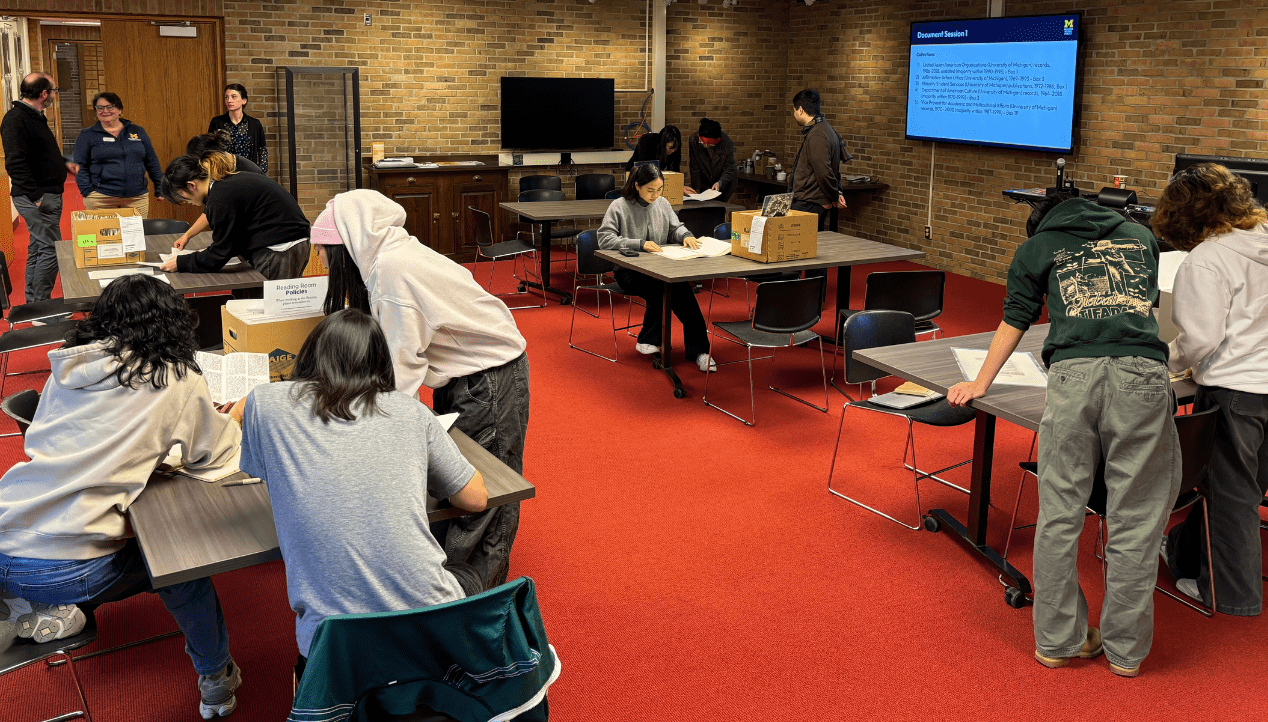
The workshop itself was great! We talked about Shared Stewardship, walked students through working in the archives and using primary sources for oral history, and then UAAO dove into the collections. When I showed scans from UAAO’s own minutes in the 1990s–where members of the new group debated whether its purpose was social, political, cultural, or administrative–I got a few laughs and groans of recognition. The response was the same when I pulled up the 1997 email cautioning frustrated students to be “wise” about how they expressed their concerns. Getting to see students dig through the archives and find documents that resonated with their own experiences really made me appreciate what can be done when you do actually have some resources–not just recognition. I mean, we even had snacks. But you don’t get resources unless you’re fortunate enough to be working alongside people who are willing to offer more than just professional words and polite appreciation.
* * * * *
One file that got a lot of attention contained an encounter between an Asian American staff member and an administrator where demands for student support turned into an explosive back and forth. Reading the exchange, I couldn’t help but feel that the advice of the Asian American program coordinator from 1997 was at least partially applicable here. I do agree that how you say something is very important. I was definitely policing my own tone when I started my candid email message with “apologies for my hectic urgency”–and I think part of that is about acknowledging that people can’t always understand stakes that they don’t see.
But, at the end of the day, it is up to us to make those stakes known somehow–and sometimes it’s hectic and urgent. How we say things matters, but so does what we say and what we do. Shared Stewardship is about communication–rethinking how we describe and share the information that institutions have produced and housed. Yet it is also about changing what we say and do as representatives of these institutions–not just giving yesterday’s “no’s” a new coat of paint. It is about holding ourselves accountable to the communities we want to “build community” with. It is about recognizing and confronting our own place in the histories we are illuminating and doing everything we can to ensure we don’t become another chapter in the same old story.
Image: United Asian American Organizations members looking at collections at the Bentley Historical Library on the Ann Arbor campus.